Sunday, December 31, 2023

[NJFAC] $ and Sense editorial: We Have the Power—How Will We Use It?

From the Editors
We Have the Power—How Will We Use It?
In 2021, the inelegantly named Expanded Child Tax Credit (ECTC) significantly increased the federal government's financial support to parents. It turned out that giving people money made them less poor. This one change alone cut child poverty in half in a single year. In 2022, in control of the White House and both houses of Congress, Democrats let the credit expire. It turned out that taking money from people made them poorer. Millions of children were thrown back into poverty, twice as many as the year before Washington took the credit away.

This grim natural experiment demonstrates what almost everyone outside the halls of Congress and other rightwing echo chambers already takes for granted: the government has the power to make those in need significantly better off, and not just in a vague, abstract way in some utopian future. It can do it right now, using tools we already have. What should we think when what passes for the party of working people, in full control of the government, can't be relied on to maintain aid to the neediest in our society,
even immediately after seeing how effective such measures are? What do we do when the government has the power to improve our lives, and chooses not to use it? Voting the right people into office is surely an important part of the equation, but the
expiration of the ECTC shows that voting alone won't do it.

Another big part of the answer comes in Barry Eidlin's feature, "Union Democracy Stands Up." Eidlin examines the late-20th-century decline and recent comeback of the Teamsters
and the UAW, two of the country's largest unions. In both unions, small but scrappy groups of rank-and-file members spent decades organizing against corruption and concessions
and for greater member control—including direct leadership elections, which are still extremely rare when it comes to deciding who will lead the labor movement. More recently, insurgent leadership turned both unions into fighting machines that won record contracts and dramatically improved the lives of hundreds of thousands of members. Whether the pieces came together slowly (as with the Teamsters) or with surprising speed (as with the UAW), the events of the last few years show that workers have the power not only to set the direction of their own unions at a national scale, but also to make their bosses pay up big. And UAW president Shawn Fain in particular has stressed that under his leadership, the union intends to fight not just for its members, but "for the entire working class."

What that looks like, exactly, remains to be seen, though Fain has already taken one big step: publicly calling on other unions to negotiate their next contracts to end at the same time the UAW's agreement with the Big Three expires, on May 1, 2028. If other
unions follow suit, they will be planting the seeds for a general strike, the kind of activity that could put not just hundreds of thousands, but millions of people into open conflict with their bosses.

Over the past decade, teachers' unions in Chicago, West Virginia, Los Angeles, and elsewhere have shown that strikes have a direct impact on public spending. Striking teachers repeatedly forced governments intent on austerity back to the table to invest
more in workers and students. Whether something comparable on a national scale will happen in 2028 is far from certain. But it would have been unimaginable just five years ago for the president of a major union, elected directly by the membership, to even discussthe prospect seriously.

What makes it possible to contemplate this scenario is union democracy—building meaningful democracy in our unions is a step toward more meaningful democracy in our country. Most people most of the time want a fairer, kinder, and gentler society. An entrenched minority who benefit from the status quo stand in the way, and with little organized pressure to oppose them, politicians mostly take their side. But as the UAW and the Teamsters show, large groups of ordinary people can be organized to create even stronger pressure. Perhaps, years from now, we'll look back at the union democracy movement as the catalyst that transformed our latent power into an economy that works for everyone.

Dollars and Sense is an excellent publication, providing economic news and analysis in accessible language. This issue also includes a commentary on unemployment by NJFAN's Frank Stricker. jz

--
June Zaccone
National Jobs for All Network
http://www.njfac.org

--
This list is only for announcements, so you may not post. To contact the list manager, write to junez [at] njfac.org
---
You received this message because you are subscribed to the Google Groups "goodjobs" group.
To unsubscribe from this group and stop receiving emails from it, send an email to goodjobsforall+unsubscribe@googlegroups.com.
To view this discussion on the web visit https://groups.google.com/d/msgid/goodjobsforall/CAPV%3DhmC%2B20yhFdkmp5V8PVm%3DuHL87Qa0dSKtNzuogTQ0pPfHBA%40mail.gmail.com.

Wednesday, December 6, 2023

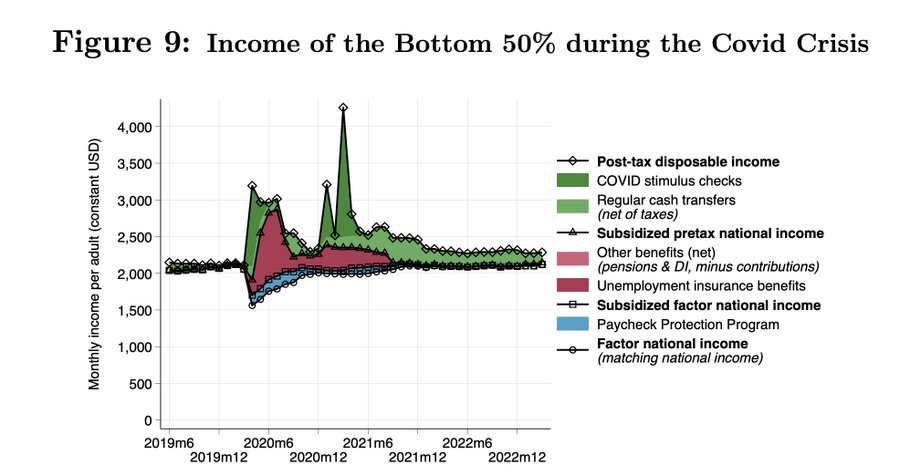
[NJFAC] decline in disposable income swamps rise in low wages

Gabriel Zucman @gabriel_zucman 
Low wages are growing, but the decline in disposable income over 2021-23 due to the phase-out of Covid policies completely swamps that — not crazy to believe this is behind a lot of people's discontent with the economy
Image

--
June Zaccone
National Jobs for All Network
http://www.njfac.org

--
This list is only for announcements, so you may not post. To contact the list manager, write to junez [at] njfac.org
---
You received this message because you are subscribed to the Google Groups "goodjobs" group.
To unsubscribe from this group and stop receiving emails from it, send an email to goodjobsforall+unsubscribe@googlegroups.com.
To view this discussion on the web visit https://groups.google.com/d/msgid/goodjobsforall/CAPV%3DhmA7fcRGVu-VLvHYuLS1bb-5AZ4-HsESOvPcOnyAf%3DPAhg%40mail.gmail.com.

Thursday, November 30, 2023

[NJFAC] Unions are industrial policy--what's new in the UAW strike

Labor Unions Are Industrial Policy

Last week, the United Auto Workers reached a deal with Stellantis to re-open an idled Belvidere Assembly Plant. "We made them invest," said transformational UAW President Shawn Fain. Lee Hepner Nov 4, 2023

....
A lot of ink has already been spilled regarding the UAW strike strategy and the generational leadership qualities of its President Shawn Fain. But what's even more interesting is how the UAW set targets beyond wages and working conditions. By causing Stellantis to revive the Belvidere facility and sealing Ford's various investment commitments, Fain and the UAW have asserted control over a realm of corporate decision-making that has, for decades, been dictated by financiers. Organized labor is dictating corporate investment decisions and setting industrial policy. Announcing the Stellantis deal, UAW President Shawn Fain made the point: "We made them invest." If the Big 3 automakers were choosing to subcontract and offshore, organized labor countered with an imperative to make things in America again....."

--
June Zaccone
National Jobs for All Network
http://www.njfac.org

--
This list is only for announcements, so you may not post. To contact the list manager, write to junez [at] njfac.org
---
You received this message because you are subscribed to the Google Groups "goodjobs" group.
To unsubscribe from this group and stop receiving emails from it, send an email to goodjobsforall+unsubscribe@googlegroups.com.
To view this discussion on the web visit https://groups.google.com/d/msgid/goodjobsforall/CAPV%3DhmCqptZQsY2hRxrD_-mhTPqY0HGP84mKk9kdoe0RENVajA%40mail.gmail.com.

Monday, October 16, 2023

[NJFAC] "fissured workplace" reducing worker power; AI jobs

In 2023, the worldwide share of employees who report being stressed at work reached a record high, according to Gallup. One contributing factor is the "fissured workplace," in which corporate managers carve up their traditional workforce and redistribute its functions to subcontractors. Often marketed in futuristic terms as a part of the tech economy, it is, in fact, a well-worn way of reducing worker power.

In response to pressures from capital markets to improve their financial performance in the 1980s and '90s, large corporations whittled down their directly employed staff to those concentrating on "core competencies," freeing them to fire "non-essential" laborers, such as janitors, whom they subsequently brought back as temps at significantly reduced pay—a domestic expression of labor arbitrage. Neoliberals argue that this corporate strategy is a win-win, liberating workers from being tied to one company, which now must compete for their services. But in reality, they are thrust into unregulated forms of employment with irregular hours, low earnings, no route for advancement, muddied relationships with management, and no business enterprise ultimately responsible for their welfare.

One of the primary characteristics of the fissured workplace is its obscured authority structure.
....
Application programming interfaces, or APIs, which hundreds of tech companies use, bring this process to perfection. APIs are used to crowdsource tasks to workers that a full-time engineering staff and its AI algorithms can't cover (or that firms won't pay to have covered by a stable of full-time employees)..... As the journalist David Zweig reports, when Twitter ratcheted up its content moderation to full-blown censorship during the coronavirus debacle, it tasked, "contractors, in places like the Philippines … to adjudicate tweets on complex topics like myocarditis and mask efficacy data." Americans were rigidly censored by on-demand workers around the world toiling for poverty wages.....

As machines are deployed by corporations to monopolize greater shares of the labor process, new forms of work are generated that require human services at the edges of AI's reach. "Thus," they write, "there is an ever-moving frontier between what machines can and can't solve…. As machines solve more and more problems, we continue to identify needs for augmenting rather than replacing human effort."

Automation, then, will create new jobs, not mass unemployment. But it doesn't necessarily follow that we will want the jobs it creates.

--
June Zaccone
National Jobs for All Network
http://www.njfac.org

--
This list is only for announcements, so you may not post. To contact the list manager, write to junez [at] njfac.org
---
You received this message because you are subscribed to the Google Groups "goodjobs" group.
To unsubscribe from this group and stop receiving emails from it, send an email to goodjobsforall+unsubscribe@googlegroups.com.
To view this discussion on the web visit https://groups.google.com/d/msgid/goodjobsforall/CAPV%3DhmDkT9puJiJq3J_AzoWRveTScHQ%2BUAusTf5os9H0ukYKrA%40mail.gmail.com.

Friday, October 13, 2023

[NJFAC] wage theft: $50+ billion a year stolen from workers


News media interested in crime—its impact on human beings, on society, its cost to the economy—would be interested in wage theft, the more than $50 billion a year stolen from workers in this country. But when is the last time your nightly local news talked about that, or encouraged you to be outraged and concerned and moved to action about that? There are efforts to address this ongoing, mundane thievery, but so far it seems to be under the radar of news outlets that, in every other way, suggest they care very much about crime, all the time.

Rodrigo Camarena is director of Justicia Lab, and co-author, with Cristobal Gutierrez, of the article "How to End Wage Theft—and Advance Immigrant Justice" that appeared earlier this month on NonProfitQuarterly.org. He is also co-creator of ¡Reclamo!, a tech-enabled initiative to combat wage theft.....


--
June Zaccone
National Jobs for All Network
http://www.njfac.org

--
This list is only for announcements, so you may not post. To contact the list manager, write to junez [at] njfac.org
---
You received this message because you are subscribed to the Google Groups "goodjobs" group.
To unsubscribe from this group and stop receiving emails from it, send an email to goodjobsforall+unsubscribe@googlegroups.com.
To view this discussion on the web visit https://groups.google.com/d/msgid/goodjobsforall/CAPV%3DhmDhqxYj3gU3pu7FWDEkzkg79th%3DqepSgU3f%3DG3J-xSjcQ%40mail.gmail.com.

Saturday, October 7, 2023

[NJFAC] Autoworkers win significant victory

Striking Autoworkers Win Shock Victory

Time for the losers and haters to eat crow Ken Klippenstein Oct 6, 2023

On Thursday, The New York Times declared the United Auto Workers' (UAW) president Shawn Fain "a confrontational figure who vilifies the automakers while alarming Wall Street" amid the UAW's strike.

The article, a profile of the newly-elected Fain, went on to describe him as "caustic," "sharp-edged," a "rebel." You get the idea: the stuff that causes monocles to fall to the ground and shatter. (In fairness, the UAW under Fain has become more assertive, as my colleague Dan Boguslaw has amusingly reported — though I think this is just a union functioning like it's supposed to.)

"Fiery words can inspire, but they can also anger," the Times article cautioned. "Now he must prove that his hard-core tactics pay off."

It is now clear, just one day after the Times article was published, that Fain's tactics have paid off. Today, the UAW stunned onlookers with an announcement that it had won a concession so significant that the union wasn't even technically allowed to strike over it. GM has formally agreed to include battery plants in the master contract, extending the benefits of the union contract to the many non-union workers in facilities manufacturing batteries for electric vehicles.

A concession of this magnitude was almost unimaginable just weeks ago and portends well for the future of the strike.

Fiery words can inspire.

--
June Zaccone
National Jobs for All Network
http://www.njfac.org

--
This list is only for announcements, so you may not post. To contact the list manager, write to junez [at] njfac.org
---
You received this message because you are subscribed to the Google Groups "goodjobs" group.
To unsubscribe from this group and stop receiving emails from it, send an email to goodjobsforall+unsubscribe@googlegroups.com.
To view this discussion on the web visit https://groups.google.com/d/msgid/goodjobsforall/CAPV%3DhmDLOrNF%2BbcT2M3tj6qDjS668MG3RPXxROZrd0JMdA%3DvYQ%40mail.gmail.com.

Wednesday, October 4, 2023

[NJFAC] Angus Deaton [who wrote on deaths of despair] on our inequality

....Rare for an economist, Deaton offers a lucid and unsparing critique of America's political system. From healthcare to taxation to poverty to regulations, Deaton sees a system that has increasingly served monopolistic corporations and the rich over ordinary citizens, allowing "a minority to prey on the majority."
....
  • Less well-educated Americans have seen little or no improvement in their material circumstances for more than fifty years. For men without a four-year college degree, median real wages have trended downward since 1970."
  • "There are several million Americans — Black, white, and Hispanic — who live in households with per capita income of a few dollars a day and whose living standards are arguably as bad as or worse than those that the World Bank demarcates as destitute in India or Ethiopia."
  • "The top 10 percent of incomes in the United States account for nearly half of all income, compared with only 14 percent for the bottom half of incomes."
  • "Overall death rates in the United States have been rising, and, even before the pandemic, adult life expectancy has fallen for ten years for those without a four-year college degree.".....
Deaton sees economists as largely as complicit in the changes that have made life harder for millions of Americans. He argues that many (but not all) of the people in his profession have provided an intellectual legitimacy for a range of policies that have stripped away support for working-class Americans and forced them into an increasingly cutthroat labor market.

"They are apostles for the globalization and technical change that have enriched an elite and have redistributed income and wealth from labor to capital, all the while destroying millions of jobs, hollowing out communities, and worsening the lives of their occupants," Angus writes. "And when confronted with deaths of despair, they can blame the victims and those who try to help them."

Going forward, Deaton urges the economics profession to think more about "predistribution — the mechanisms that determine the distribution of income in the market itself, before taxes and transfers — and less about a redistribution that is not going to happen and is not what people want in any case." That, he stresses, will force many economists into "uncomfortable territory: promoting unions, place-based policies, immigration control, tariffs, job preservation, industrial policy, and the like. We need to promote a more realistic understanding of how governments and markets work. We need to abandon our sole fixation on money as a measure of human wellbeing."
....

This is wise policy. After income is already paid, many recipients are likely to resist relinquishing some. Predistribution avoids this. Methods include a national job guarantee at decent wages, though we should still consider a return to the higher taxes that predated Reagan.   jz


--
June Zaccone
National Jobs for All Network
http://www.njfac.org

--
This list is only for announcements, so you may not post. To contact the list manager, write to junez [at] njfac.org
---
You received this message because you are subscribed to the Google Groups "goodjobs" group.
To unsubscribe from this group and stop receiving emails from it, send an email to goodjobsforall+unsubscribe@googlegroups.com.
To view this discussion on the web visit https://groups.google.com/d/msgid/goodjobsforall/CAPV%3DhmBNUFmV_rz1iVUmfQw5gN4vRUiebTE6HtMoNongfCPPfA%40mail.gmail.com.