Monday, November 16, 2015

[NJFAC] How a ‘Right to Your Job’ Law Could Help Unions Fight Back Against ‘Right to Work’

How a 'Right to Your Job' Law Could Help Unions Fight Back Against 'Right to Work'

BY Shaun Richman Nov 16, 2015

The sword of Damocles hangs over the head of the American labor movement. This spring the U.S. Supreme Court will rule on Friedrichs vs. CTA, a case that could end automatic union membership in all government jobs. If this "right to work" effort goes the way the right wing hopes, it would be followed by an aggressive and well-funded direct mail and robo-call campaign to encourage public sector employees to "give yourself a raise" by dropping their union memberships and ceasing to pay dues or fees.

Misleadingly titled "right to work" laws prohibit unions in the private sector from negotiating fees for the services they are compelled to provide to all workers they represent. They are designed to reduce unions' income and power. First introduced in 1947, these laws used to be limited to the former slave states of the Confederacy. But in recent years, a coordinated right-wing drive has expanded these laws to a majority of states, including union strongholds like Michigan and Indiana. Thanks in part to such laws, unions today represent only 7 percent of private sector workers. But factoring in the public sector raises total union density to 12 percent. Unions with substantial public sector membership—AFSCME, SEIU, the teachers unions—are the last remaining large, powerful unions in the U.S. Friedrichs is nothing less than an assassination attempt on the union movement.

....According to a recent Gallop poll, 58% of Americans support unions and want to see them strengthened. Research shows that one in three American workers would vote for a union at their workplace if an election were held today.

But a union election won't be held today at most workplaces. Vicious employer resistance and retaliation, a broken legal process and declining union resources stand in the way of most workplaces winning the majority vote that is required in our all-or-nothing union representation system. 

Of course, the workers who want a union want… a union. They want an organization that can help raise their wages and improve their benefits, protect them from arbitrary and capricious firings and gives them voice in how things get done at work. All that a union can provide an at-large member right now is discount AT&T cell phone plans and pet health insurance. At-large memberships are not likely to lead to millions of new union members.

But there might be a couple hundred thousand people willing to pay 10 bucks a month to belong to a movement. Potentially faced with the immediate loss of exactly that many current members, that's an attractive proposition to unions. The key will be to actually bring a movement into people's homes, and that means connecting at-large union membership with advocacy and legislative campaigns.

A "right to your job" movement

Opening up the labor movement and pursuing new rights for all workers would help get labor out of the box of thinking mostly about unionized workplaces and appearing to be a special interest. Unions' recent embrace of ambitious efforts to raise state-level minimum wages to $15 has so far been at the heart of these efforts. Upwards of 24 million working people would receive a raise if the pathetic federal floor of $7.25 an hour was raised to just $10, so the Fight for $15 has a huge built in constituency beyond just fast food workers.

....

Imagine how quickly the debate would change if unions fought for and won meaningful job protections for all workers in a state! Call it a "right to your job" law. Such a law would lay bare just how cynically manipulative and hollow the so-called "Right to Work" laws are.

To be meaningful, such just cause laws would have to include some kind of a court in which to hear cases. This could be as simple as mandating private mediation and arbitration or as complex as creating new state regulatory agencies to hear such cases. If workers did have a court in which they could defend their employment, unions would have something real to offer at-large members as a part of joining the union. And with that offer comes the potential for substantial membership growth.

A radical departure for labor

Attempting to legislate job protections, pay and benefit increases for large groups of workers who probably won't become dues-paying union members would be a radical departure for the American labor movement. Unions have, for historical reasons, preferred to make their gains in contract bargaining. The early labor movement, in the 19th century, did work to pass laws on wages, hours and factory conditions. They saw most of those laws overturned, as well as many of their strikes and boycotts enjoined, by conservative courts that viewed unions' efforts as violations of private contracts and disturbances of interstate commerce.....

[Of course, a "right to A job" would be even better. j]

--
National Jobs for All Coalition
http://www.njfac.org/

--
This list is only for announcements, so you may not post. To contact the list manager, write to njfac [at] njfac.org
---
You received this message because you are subscribed to the Google Groups "goodjobs" group.
To unsubscribe from this group and stop receiving emails from it, send an email to goodjobsforall+unsubscribe@googlegroups.com.
For more options, visit https://groups.google.com/d/optout.

Thursday, July 16, 2015

[NJFAC] the jobless future isn’t a luddite fallacy

Sorry, but the jobless future isn't a luddite fallacy

Vivek Wadhwa Jul 7th 2015 -
 With the unemployment rate falling to 5.3 percent, the lowest in seven years, policy makers are heaving a sigh of relief. Indeed, with the technology boom in progress, there is a lot to be optimistic about. Manufacturing will be returning to U.S. shores with robots doing the job of Chinese workers; American carmakers will be mass-producing self-driving electric vehicles; technology companies will develop medical devices that greatly improve health and longevity; we will have unlimited clean energy and 3D-print our daily needs. The cost of all of these things will plummet and make it possible to provide for the basic needs of every human being.

I am talking about technology advances that are happening now, which will bear fruit in the 2020s.

But policy makers will have a big new problem to deal with: the disappearance of human jobs. Not only will there be fewer jobs for people doing manual work, the jobs of knowledge workers will also be replaced by computers. Almost every industry and profession will be impacted and this will create a new set of social problems — because most people can't adapt to such dramatic change.

If we can develop the economic structures necessary to distribute the prosperity we are creating, most people will no longer have to work to sustain themselves. They will be free to pursue other creative endeavors. The problem, however, is that without jobs, they will not have the dignity, social engagement, and sense of fulfillment that comes from work. The life, liberty and pursuit of happiness that the constitution entitles us to won't be through labor, it will have to be through other means.

It is imperative that we understand the changes that are happening and find ways to cushion the impacts.
....
The industrial revolution unfolded over centuries. Today's technology revolutions are happening within years. We will surely create a few intellectually-challenging jobs, but we won't be able to retrain the workers who lose today's jobs. They will experience the same unemployment and despair that their forefathers did. It is they who we need to worry about.
The first large wave of unemployment will be caused by self-driving cars. These will provide tremendous benefit by eliminating traffic accidents and congestion, making commuting time more productive, and reducing energy usage. But they will eliminate the jobs of millions of taxi and truck drivers and delivery people. Fully-automated robotic cars are no longer in the realm of science fiction; you can see Google's cars on the streets of Mountain View, Calif. There are also self-driving trucks on our highways and self-driving tractors on farms. Uber just hired away dozens of engineers from Carnegie Mellon University to build its own robotic cars. It will surely start replacing its human drivers as soon as its technology is ready — later in this decade. As Uber CEO Travis Kalanick reportedly said in an interview, "The reason Uber could be expensive is you're paying for the other dude in the car. When there is no other dude in the car, the cost of taking an Uber anywhere is cheaper. Even on a road trip."

The dude in the driver's seat will go away.

Manufacturing will be the next industry to be transformed. Robots have, for many years, been able to perform surgery, milk cows, do military reconnaissance and combat, and assemble goods. But they weren't dexterous enough to do the type of work that humans do in installing circuit boards. The latest generation of industrial robots by ABB of Switzerland and Rethink Robotics of Boston can do this however. ABB's robot, Yumi, can even thread a needle. It costs only $40,000.

China, fearing the demise of its industry, is setting up fully-automated robotic factories in the hope that by becoming more price-competitive, it can continue to be the manufacturing capital of the world. But its advantage only holds up as long as the supply chains are in China and shipping raw materials and finished goods over the oceans remains cost-effective. Don't forget that our robots are as productive as theirs are; they too don't join labor unions (yet) and will work around the clock without complaining. Supply chains will surely shift and the trickle of returning manufacturing will become a flood.

But there will be few jobs for humans once the new, local factories are built.

With advances in artificial intelligence, any job that requires the analysis of information can be done better by computers. This includes the jobs of physicians, lawyers, accountants, and stock brokers. We will still need some humans to interact with the ones who prefer human contact, but the grunt work will disappear. The machines will need very few humans to help them.

This jobless future will surely create social problems — but it may be an opportunity for humanity to uplift itself. Why do we need to work 40, 50, or 60 hours a week, after all? Just as we were better off leaving the long and hard agrarian and factory jobs behind, we may be better off without the mindless work at the office. What if we could be working 10 or 15 hours per week from anywhere we want and have the remaining time for leisure, social work, or attainment of knowledge?

Yes, there will be a booming tourism and recreation industry and new jobs will be created in these — for some people.

There are as many things to be excited about as to fear. If we are smart enough to develop technologies that solve the problems of disease, hunger, energy, and education, we can — and surely will — develop solutions to our social problems. But we need to start by understanding where we are headed and prepare for the changes. We need to get beyond the claims of a Luddite fallacy — to a discussion about the new future.
--
National Jobs for All Coalition
http://www.njfac.org/
--
This list is only for announcements, so you may not post. To contact the list manager, write to njfac [at] njfac.org
---
You received this message because you are subscribed to the Google Groups "goodjobs" group.
To unsubscribe from this group and stop receiving emails from it, send an email to goodjobsforall+unsubscribe@googlegroups.com.
For more options, visit https://groups.google.com/d/optout.

Monday, July 6, 2015

[NJFAC] Minimum Wage — Solid Benefits, Small Costs

Chad Stone, CBPP June 30, 2015

After reviewing more than 200 scholarly papers on the minimum wage for their book What Does the Minimum Wage Do?, Dale Belman and Paul J. Wolfson have found that it does pretty much what policymakers intended it to.

Their conclusions, in a nutshell:

[I]ncreases in the minimum wage raise the hourly wage and earnings of workers in the lower part of the wage distribution and have very modest or no effects on employment, hours, and other labor market outcomes. The minimum wage can then, as originally intended, be used to improve the conditions of those working in the least remunerative sectors of the labor market. While not a full solution to the issues of low-wage work, it is a useful instrument of policy that has low social costs and clear benefits.

This thorough study recently won Princeton University's 2014 Bowen Award for the year's outstanding book on labor and public policy.

Belman and Wolfson describe the above conclusions as "things we know with confidence" -- with the caveat that they come from studies of moderate minimum wage increases like those in the United States over the past few decades.

Their findings, they note, don't square with critics' claims that the minimum wage has unintended consequences that defeat its purpose by raising unemployment among low-income workers and providing too many benefits to people who don't need them:

The moderate increases seen in the United States have resulted in increased earnings with little or no effect on employment. The increase in earnings has gone largely to households in the lower half of the earnings distribution.

Critics often call for scrapping the minimum wage because the Earned Income Tax Credit (EITC) provides a better way of helping low-wage workers. Belman and Wolfson have a more nuanced reading, more consistent with the views of those of us who think the minimum wage and EITC are complementary policies, not competing approaches, for achieving the same goal:

While not a stand-alone policy for resolving the issues of low income in the United States, the effectiveness of moderate increases in the minimum wage in raising earnings with few negative consequences makes it an important tool for labor market policy.

Policymakers have to consider many practical questions in crafting legislation to raise the minimum wage. But they shouldn't be swayed by arguments that it doesn't have the intended positive effects. The evidence is strong that it does.

--
National Jobs for All Coalition
http://www.njfac.org/

--
This list is only for announcements, so you may not post. To contact the list manager, write to njfac [at] njfac.org
---
You received this message because you are subscribed to the Google Groups "goodjobs" group.
To unsubscribe from this group and stop receiving emails from it, send an email to goodjobsforall+unsubscribe@googlegroups.com.
For more options, visit https://groups.google.com/d/optout.

Sunday, June 28, 2015

[NJFAC] The dark side of involuntary part-time work

  June 25, 2015

Many part-time workers were left behind by the economic recovery.

Nearly half of the 26.5 million Americans (46%) who work part-time are desperate to work full-time, according to a new report — "A Tale of Two Workforces: The Benefits and Burdens of Working Part Time" — by Rutgers University. The vast majority of the nation's 26 million part-time workers — from college students working in coffee shops between classes to freelance computer software designers working for multinationals — receive no benefits beyond their paychecks and almost one-third say their financial condition is flat out poor.

Nearly one-in-five American workers is employed in a part-time job, logging fewer than 35 hours a week. Some 20 million people, known as voluntary part-time workers, do so to supplement their income, pursue an education, or care for children, but another 6.5 million Americans, so-called involuntary part-time employees, want a full-time job but can't find one. The persistence of such large numbers of involuntary part-time workers is an indicator of underlying weaknesses in the U.S. labor market six years since the beginning of the economic recovery, the study found.

These part-time workers are also divided along ethnic lines. Voluntary part-time workers are disproportionately white, while involuntary part-time workers are disproportionately from a minority, especially Hispanic. Although white Americans make up around 63% of the general population, they comprise 72% of voluntary part-time workers, and just 54% of involuntary ones. Hispanics account for 23% of involuntary part-time workers, and African-Americans account for another 15%, for a total of 38%.....


--
National Jobs for All Coalition
http://www.njfac.org/

--
This list is only for announcements, so you may not post. To contact the list manager, write to njfac [at] njfac.org
---
You received this message because you are subscribed to the Google Groups "goodjobs" group.
To unsubscribe from this group and stop receiving emails from it, send an email to goodjobsforall+unsubscribe@googlegroups.com.
For more options, visit https://groups.google.com/d/optout.

Thursday, June 25, 2015

[NJFAC] Jobs: The second job you don’t know you have; the "sharing" economy

The second job you don't know you have

How self-checkouts, ATMs and airport check-ins are changing our economy. By 5/15

Technology has knocked the bottom rung out of the employment ladder, which has sent youth unemployment around the globe skyrocketing and presented us with a serious economic dilemma. While many have focused on the poor state of our educational system or the "jobless" recovery, another, overlooked factor behind this trend is the phenomenon of "shadow work." I define shadow work as all the unpaid jobs we do on behalf of businesses and organizations: We are pumping our own gas, scanning our own groceries, booking our travel and busing our tables at Starbucks. Shadow work is a new concept, so as yet, no one has compiled economic data on how many jobs we, the consumers, have taken over from (erstwhile) employees. Yet it is surely a force shrinking the job market, and the unemployment it creates is structural. Thanks in part to this new phenomenon, widespread joblessness could become entrenched in the social landscape.

Consider what you now do yourself: You can bank on your cell phone, check yourself out at CVS or the grocery store without ever speaking to an employee, book your own flights and print your boarding pass at the airport without ever talking to a ticket agent — and that's just in the last few years. Imagine what's coming next.....

How Everyone Gets the 'Sharing' Economy Wrong
Uber isn't the Uber for rides—it's the Uber for low-wage jobs
  Christopher Mims, Wall St.Journal, May 24, 2015 

If you want to start a fight in otherwise polite company, just declare that the "sharing economy" is the new feudalism, or else that it's the future of work and all the serfs should just get used to it, already.....

In the minds of critics, perhaps the worst offender in how it controls its labor force is Uber. Uber sets the prices that its drivers must accept, and has lately been in the habit of unilaterally squeezing drivers in two ways, both by lowering the rates drivers are paid per trip and increasing Uber's cut of those wages….

Boosters of companies like Uber counter that they allow for relatively well-compensated work, on demand. When I asked them for comment, Uber officials pointed to previously released data suggesting just that. The most recent report, a collaboration between Uber and economist Alan Krueger, paints a fairly rosy picture of Uber's job-creation abilities. Uber has said in the past that world-wide it is hiring 20,000 new drivers a month, and in this report it claims that in major American cities like Los Angeles and Washington, D.C., drivers are averaging more than $17 an hour.

But this data doesn't reflect what Uber drivers actually make, for the simple reason that it doesn't include drivers' expenses. Work by investigative journalist Emily Guendelsberger, for example, shows that Uber drivers in Philadelphia, a fairly typical city for the service, are probably earning only a fraction of that. According to Ms. Guendelsberger's admittedly limited sample of 20 drivers, including herself, it was around $10 an hour after expenses.

It isn't minimum wage, but it's a far cry from Uber's previous claims about what drivers make, which reached the height of absurdity in May 2014, when the company claimed that the median income for drivers in New York was $90,000 a year. Months of investigation of that claim by journalist Alison Griswold yielded not a single driver in New York making that much.

What this all means is simple: Uber and its kin Lyft, which is more generous with its drivers but has a similar business model, are remarkably efficient machines for producing near minimum-wage jobs. Uber isn't the Uber for rides— it's the Uber for low-wage jobs.....


-- 
National Jobs for All Coalition
http://www.njfac.org/

--
This list is only for announcements, so you may not post. To contact the list manager, write to njfac [at] njfac.org
---
You received this message because you are subscribed to the Google Groups "goodjobs" group.
To unsubscribe from this group and stop receiving emails from it, send an email to goodjobsforall+unsubscribe@googlegroups.com.
For more options, visit https://groups.google.com/d/optout.

Thursday, June 18, 2015

[NJFAC] Half of American Families Staring at Financial Catastrophe

Half of All American Families Are Staring at Financial Catastrophe

And they're turning to payday loans and other lenders of last resort when crises occur. Kriston Capps May 29, 2015

....

"Forty-seven percent of respondents say they either could not cover an emergency expense costing $400, or would cover it by selling something or borrowing money," reads this year's annual report.

Maybe Americans are feeling better about their finances, as The Wall Street Journal puts it, but that figure is a downer. Several years into the recovery, almost half of all U.S. households could not withstand a minor financial shock without incurring debt or liquidating assets.  

Forty-seven percent of respondents could not cover an emergency expense of $400, or would have to sell something or borrow money.

"Even prior to the [Great Recession], and more acutely after the recession, it's true, American households are vulnerable," says Gregory B. Mills, senior fellow at the Urban Institute. "Depending upon the measure you use, somewhere between one-third and one-half of households are at great risk—as in, they would be unable to fend off hardship."

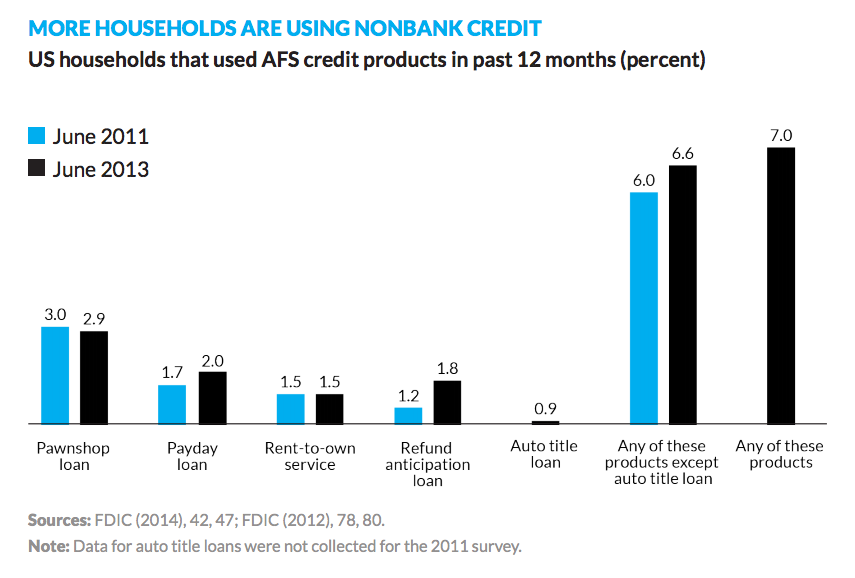
Families' savings not where they should be: That's one part of the problem. But Mills sees something else in the recovery that's more disturbing. The number of households tapping alternative financial services are on the rise, meaning that Americans are turning to non-bank lenders for credit: payday loans, refund-anticipation loans, pawnshops, and rent-to-own services.

According to the Urban Institute report, the number of households that used alternative credit products increased 7 percent between 2011 and 2013. And the kind of household seeking alternative financing is changing, too.

                                                                                                                                                    (Urban Institute)

While that figure might seem small—it's an increase of about 750,000 households total—it's a significant figure for the economy in recovery. Families that are looking for credit aren't finding it in mainstream financial institutions. "You used to be able to get small loans for reasonable rates, below 36 percent," Mills says. "That's what's opened the door for more predatory products."

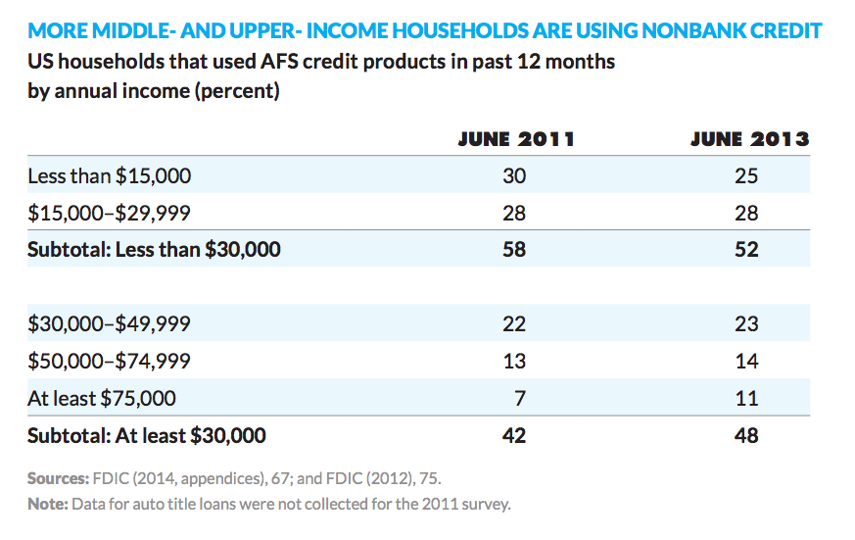
The nature of households looking for alternative financial products, including predatory loans, has morphed during the recovery. According to Mills's research, the share of households seeking non-bank credit with incomes above $30,000 increased from 42 to 48 percent between 2011 and 2013. And the share making more than $75,000 increased from 7 to 11 percent over the same span.

                                                                                                                                                    (Urban Institute)

It's not the case that every one of these middle- and upper-class households turned to pawnshops and payday lenders because they got whomped by an unexpected bill from a mechanic or a dentist. "People who are in these [non-bank] situations are not using these forms of credit to simply overcome an emergency, but are using them for basic living experiences," Mills says.

More middle- and upper-income households are using alternative financial products, including predatory loans.

Still, survey respondents who said they couldn't weather a $400 hit are bound to be some of the same folks who are turning to non-bank lenders for routine expenses. That's a huge problem nationwide. Alternative financial services come with steep interest rates, especially payday lenders, which lock borrowers into vicious lending cycles with interest rates north of 400 to 500 percent. The Consumer Financial Protection Bureau is moving to regulate the payday lender sphere—which is a good start.

Here's another disquieting finding from the Fed: "Nearly a third of respondents went without some medical treatment in the past year because they could not afford it." Later this summer, 7.5 million Americans will find out whether or not they will get to keep their healthcare policies. Guess they better cross their fingers.

[Have you wondered why output growth is slow? J]
--
National Jobs for All Coalition
http://www.njfac.org/

--
This list is only for announcements, so you may not post. To contact the list manager, write to njfac [at] njfac.org
---
You received this message because you are subscribed to the Google Groups "goodjobs" group.
To unsubscribe from this group and stop receiving emails from it, send an email to goodjobsforall+unsubscribe@googlegroups.com.
For more options, visit https://groups.google.com/d/optout.

Wednesday, June 10, 2015

[NJFAC] Long-term unemployment trends--BLS

Trends in long-term unemployment March 2015

Karen Kosanovich and Eleni Theodossiou Sherman

Long-term unemployment reached historically high levels following the Great Recession of 2007–2009. Both the number and share of the unemployed who are long-term unemployed typically continue to increase after a recession ends, before falling during a labor market recovery.  Following this cyclical pattern, long-term unemployment has fallen in recent years, although it remains high by historical standards. Five years after the Great Recession ended, the number of long-term unemployed still made up a larger share of unemployment than during any previous recession.

This Spotlight on Statistics examines trends in long-term unemployment and the characteristics of people who have experienced it.

A good slide-show of data organized by categories--age, gender, race, education, etc.

--
National Jobs for All Coalition
http://www.njfac.org/

--
This list is only for announcements, so you may not post. To contact the list manager, write to njfac [at] njfac.org
---
You received this message because you are subscribed to the Google Groups "goodjobs" group.
To unsubscribe from this group and stop receiving emails from it, send an email to goodjobsforall+unsubscribe@googlegroups.com.
For more options, visit https://groups.google.com/d/optout.