Tuesday, April 26, 2022

[NJFAC] National Jobs for All Network - Newsletter Issue April 2022

View this email in your browser
National Jobs for All Network
_______________________________________________________________________
P.O. Box 96, Lynbrook, NY 11563 · njfan@njfac.org · www.njfac.org 
Newsletter Issue April 2022
In this issue:

  • Are We Witnessing a Rebirth of Unions?
  • The Problem in New York City is Too Few Jobs
  • Uniting for Voting Rights (Letter to the Editor, NY Times, 1/27/22)
  • Making Volunteer Work More Visible
  • Seven Points about the March Job Reports
  • The Full Count: March 2022 Unemployment Data
  • Chuck Bell: NJFAN'S Tireless, Thoughtful Vice Chair 
  • Get Involved!
April 2022 Newsletter
EmailEmail
FacebookFacebook
LinkedInLinkedIn
TwitterTwitter

Are We Witnessing a Rebirth of Unions?


By GREGORY N. HEIRES
 
Unions appear to be making a comeback as the Covid-19 economic crisis has emboldened workers and stirred up longstanding outrage over inequality and inadequate wages and benefits.
 
In an historic victory in late March, workers at an Amazon warehouse in Staten Island voted to be represented by a union. They are the first workers to successfully organize a union at the tech giant.
 
Also in March, workers at a Starbucks store in Mesa, Arizona voted to unionize. The vote was the latest victory of a nationwide organizing drive that so far also resulted in victories at five stores in the Buffalo, N.Y. area, another store in Mesa, and one in Seattle, the hometown of the coffee chain. The union has petitioned to hold union elections at 150 stores in 27 states.
 
And in another sign of an increasingly aggressive union movement, workers at Condé Nast announced in March that they are seeking representation. The group includes 500 editorial, production, and video workers at publications where workers haven't already unionized, including GQ, Vogue, Vanity Fair, and Architectural Review.

But despite the growing activism, unions still face enormous challenges. Employers continue to pour millions into resisting organizing drives. Not all union leaders have adopted aggressive organizing strategies, choosing instead to pour resources into defending their base. And after many years of declining membership, unions remain stuck in a deep hole.
  
Read More  

EmailEmail
FacebookFacebook
LinkedInLinkedIn
TwitterTwitter

The Problem in New York City is Too Few Jobs


The last NJFAN newsletter featured a letter sent to New York City Mayor-elect Eric Adams challenging his assertion that the problem in New York is not lack of jobs but lack of access to jobs--and urging him to create jobs in the tradition of his predecessor Mayor Fiorello LaGuardia. The letter was signed by NJFAN Advisory Board member Franklin D. Roosevelt III, NJFAC Chair Trudy Goldberg, and Executive Committee member Noreen Connell who initiated this project.

After reading the letter, Executive Committee member Alan Aja suggested that our call for job creation reach a wider audience. With more current data on unemployment and again taking issue with Mayor Adam's inaccurate definition of the employment problem, the following op-ed appeared in the New York Daily News March 19th. The response has been very positive, including some interest on the part of elected officials.

Officeholders all over the country need to hear from you about jobs and wages in your city or state. We urge you to follow the example of our leaders. Let the public and their representatives know how you define the problem and the solution. Let us know your action and public responses to it so that we can share the news with other advocates of a Job Guarantee.


The problem, Mr. Mayor, is too few jobs — not too little access
By TRUDY GOLDBERG, NOREEN CONNELL and ALAN AJA
NEW YORK DAILY NEWS | MAR 19, 2022, AT 5:00 AM


Amid the crowded Democratic primary for mayor, some candidates, including Maya Wiley, Dianne Morales and Scott Stringer, promised upwards of 100,000 new jobs with "hire local" provisions. But candidate Eric Adams had no such plans. He asserted that "the biggest problem is not lack of jobs, it's the lack of access to jobs." Since problem definitions are the basis for problem solutions, it is important to refute Adams' assertion that there is no lack of jobs in New York City.
 
A recent report from the New School's Center for New York City Affairs painted a startling reality quite counter to that of Adams. Despite a marginal economic recovery over the last year that still leaves the city behind the rest of the country, the city's pandemic jobs deficit in January 2022 stood at 317,000 jobs, or 6.8% (compared to -2.3% nationwide), and its latest unemployment rate is 7.3%, almost twice the seasonally adjusted national figure. For Black and Hispanic communities, the unemployment rate during the latest quarter was even more alarming — 15.2% and 10.2%, respectively.

Moreover, official unemployment rates seriously undercount real joblessness because they omit part-time workers who want but are unable to get full-time jobs and persons who would like a job but aren't currently looking for such reasons as lack of child care, transportation and — during a pandemic — fear of contagion.
  
Read More  


EmailEmail
FacebookFacebook
LinkedInLinkedIn
TwitterTwitter

Uniting for Voting Rights (Letter to the Editor, NY Times, 1/27/22)

By NJFAN CHAIR, TRUDY GOLDBERG
Re "How Did Democrats Let This Happen?," by Bishop Reginald T. Jackson (Opinion guest essay, Jan. 17):
Bishop Reginald T. Jackson calls out Democrats and especially President Biden for failure to lead the fight to protect voting rights. Presidential leadership is critical, but so is a strong movement to back it up.
One source of widespread support for a save democracy movement is the numerous organizations promoting economic, social, racial and gender justice that often pursue their goals separately.
Justice advocates have good reason — in addition to the obvious one of saving government for and by the people — to throw their full weight behind protection of voting rights.
The current assault on democracy targets the voting rights of the very groups who are likely to vote for and stand to gain most from progressive legislation like access to affordable health care and child care, decent housing, a guarantee of living-wage work and workplace rights.
That is why those engaged in the struggle for economic and social justice must make preservation of democracy and voting rights integral to their goals and struggles. Let us put aside the siloing that often characterizes our work and unite to preserve democracy.
Gertrude Schaffner Goldberg
New Canaan, Conn.
The writer is chair of the National Jobs for All Network.
EmailEmail
FacebookFacebook
LinkedInLinkedIn
TwitterTwitter

Making Volunteer Work More Visible


By TRUDY GOLDBERG

A great deal of work in the United States is done by volunteers who are not counted as employed in official statistics of the U.S. Bureau of Labor Statistics—even if their work is done in a traditional workplace. Why? Because they are not paid. John A. Turner, Bruce W. Klein, and Constance Sorrentino, three researchers who consider making volunteer work more visible, point out that two persons doing the same work—one working in retail sales and being paid is counted as employed, while another doing nearly identical work in a charity organization consignment shop, is not counted as employed. Under the current definition of unemployment people are considered employed—only if they work for pay or profit.[1]
 
Turner, Klein, and Sorrentino consider whether there should be an expanded definition of employment based on the nature of the activity people are doing and not solely on monetary compensation. They presented the findings of their study at a recent meeting of the Columbia University Seminar on Full Employment, Social Welfare, and Equity, with which NJFAN is closely associated. Turner, Klein, and Sorrentino cite the Johns Hopkins Volunteer Measurement Project: "Including volunteering as a subset of work means that the tangible and invaluable contributions volunteering makes to individuals and society are being recognized as a force that should be tracked and measured so that it can be better supported and fostered."[2] The number of volunteers in the United States is quite substantial—63 million or 25% of the population in a recent year. Older people volunteer at about the same rate as the general population, but median hours of volunteer work of people 65 and older are close to double that of the total population 16 and over. 
 
Thus, by omitting volunteer labor from official employment statistics, the Bureau of Labor Statistics leaves out a substantial amount of work performed in the U.S. economy. The authors of this article do not suggest changes in the official statistical concepts of the U.S. Bureau of Labor Statistics since consistency is important in a historical data series. However, they discuss issues pertaining to an expanded measure of work that would supplement the current definition by including volunteers, and they construct a measure consistent with that definition from data in currently available surveys. These measures, they write, would be particularly useful for understanding the labor force activity of older people--especially those workers retired from regular employment and doing volunteer work. Moreover, they point out, the Covid-19 pandemic has heightened the importance of volunteering—even though the measure of volunteer work they propose does not include "direct volunteers" who provide help on their own such as shopping or household chores. Such direct volunteering greatly increased during the Pandemic. The measure proposed by Turner, Klein, and Sorrentino, however, is confined to volunteer work provided through an organization because that is the current statistical definition of volunteers used in the United States. New data collections would be required to broaden the definition to encompass all volunteers.
  
Read More  

 
EmailEmail
FacebookFacebook
LinkedInLinkedIn
TwitterTwitter

Seven Points about the March Job Reports

             
By FRANK STRICKER 

1. Unemployment. Unemployment fell again, reaching 3.6%. That's about where it was in February of 2020.
But the rates for some categories are still terribly high: African-Americans: 6.2%; Disabled Persons: 8.8%; Teens: 10%; and Black Teens: 22.9%.

2. Job Totals. Employers added 431,000 non-farm jobs. Not blockbuster numbers but a C+. Areas that did well included retail trade and transport and warehouse employment. The health-care sector changed little in March, and it is still about 300,000 below pre-pandemic levels, despite the fact that there are more sick people.

3. What's normal? Some commentators have announced that we are back to full employment or at least normal unemployment. Non-farm jobs were just 1.6 million below February 2020. But we need to think more deeply. Even to get back to conventional normal, we actually need 4 million jobs because--surprise--the population and potential labor force increased over two years. Furthermore, conventional normal leaves out millions of people who want jobs but are just outside the labor force and not counted as unemployed because they aren't actively searching for work. The National Jobs for All Network emphasizes that while there were only 6 million officially unemployed persons in March, there were 5.7 million job-wanters not currently searching and 4.2 million part-time workers who wanted full-time work (See the Full Count for March in this issue). The total number of people who wanted a job or an upgrade was 15.9 million. To clear out just half of that deficit would require 8 million jobs.  

4. Plenty of Job Vacancies? In January and February, the number of job openings reported by employers fell a bit from record-high levels to around 10.7 million. Worker quit-rates also fell slightly. On paper there are job openings for many of the unemployed and underemployed. But perhaps some openings are phantoms. We hear occasionally from persons who answer many job postings and never hear back. But aside from the possibility that some vacancies aren't real, something important is still happening.

5. The Great Resignation-and-Resistance Movement Continues. It may be losing a little steam, but quit-rates are still unusually high and so is the number of unionization drives. A handful of Starbucks stores have voted to go union, and a hundred more are petitioning for a vote. An independent union on Staten Island, the Amazon Labor Union, is the first ever to win an election at an Amazon warehouse. It's nothing new that people are unhappy with their jobs, but more are willing to act upon that feeling by quitting to go home or find a new job, or by organizing. These are rational responses to years of workplace oppression for millions of workers.
  
Read More  

EmailEmail
FacebookFacebook
LinkedInLinkedIn
TwitterTwitter

The Full Count: March 2022
Unemployment Data

Officially unemployed: 6.0 MILLION (3.6%)

Hidden unemployment: 9.9 million
(Includes 4.2 million people working part-time

because they can't find a full-time job;
and 5.7 million people who want jobs,
but are not actively looking)
Total: 15.9 MILLION (9.3% of the labor force)

There are 1.4 job-wanters for each available job!

For more information and analysis, visit: www.njfac.org

Source: U.S. Bureau of Labor Statistics

Employment Statistics


Since its founding in 1994, the National Jobs for All Network (previously Coalition) has been "telling the whole story" about unemployment.*

Our founders recognized that the official unemployment rate reported monthly by the Labor Department leaves out more jobless and job short workers than it includes. To be counted as unemployed, one must work less than one hour a week in paid employment and be actively seeking employment. As the above figures show, more than half the unemployed or underemployed are left out of the official count. Consider the political consequences of this undercount—of a problem perceived by the public as less than half as widespread as it really is.

*See "Unemployment Statistics: Let's Tell the Whole Story" by NJFAC founders Helen Lachs Ginsburg, Bill Ayres, and June Zaccone, Employment Statistics: Let's Tell the Whole Story - NJFAC
 
EmailEmail
FacebookFacebook
LinkedInLinkedIn
TwitterTwitter

Chuck Bell: NJFAN'S Tireless, Thoughtful Vice Chair 


By SHEILA D. COLLINS
 
Charles (Chuck) Bell wears many hats with the NJFAN. He serves as NJFAN's Vice-Chair, as legislative affairs specialist, and works to keep the website going and assist in the production of our newsletters. He does all of this on top of a full-time job as Programs Director for Consumer Reports, where he works on a wide range of consumer policy issues, including financial services, auto insurance, student loans, product safety, food safety, digital privacy, and energy efficiency. 
 
A life-long social justice advocate, Chuck comes by this commitment from an early age. His parents were active in social movements for civil rights, peace in Vietnam, and women's rights. When he was three or four, he remembers that his mother went to sit on the White House steps to call for a nuclear test ban treaty. At the age of eleven or twelve, he attended a teach-in about Vietnam, and in the 1980s, between spells of unemployment, he worked for a food bank and a peace organization in Oregon. Over the course of his life he has championed consumers' rights, economic justice, affordable housing, clean energy, immigration reform, and peace and opposition to militarism. In addition to his writing for NJFAN, Chuck has published many articles in such publications as the Charlotte ObserverGannett Suburban Newspapers, the San Francisco Examiner & Chronicle, the Seattle Times, and the Bulletin of the New York Academy of Medicine.

Chuck has been with the NJFAN (formerly the National Jobs for All Coalition or NJFAC) from its inception. He says: The issue resonated with me because my first real job at the Portland Food Bank was a federally-subsidized public service employment job. I love the idea of expanding job opportunities for everyone who wants to work, by getting the government to invest in infrastructure and social services that are not provided by the private market. That's a win-win solution for people and the economy as a whole.
 
When asked how he sees NJFAN's importance and its focus on a job guarantee Chuck recalled that Sumner Rosen, one of NJFAC's founders, used to say, "A good job is a consumer's best friend," and Chuck says it's very true. It's hard to have a decent life if you don't have two nickels to rub together. There's a chronic shortage of enough dignified jobs with decent pay and benefits for everyone who wants to work. If workers had a legal right to a decent job, employers would have to pay everyone better and treat workers more fairly. A job guarantee is also a close cousin to other universal economic rights that are vital for a fair economy, such as health care for all, retirement savings for all, and child care for all. And finally, a job guarantee would help us to have a fair transition to a clean energy economy since it would assure that workers who are affected by changes in the energy sector would still have a good place to work.
  
Read More  

Get Involved!


Join! Donate! Subscribe!

The National Jobs for All Network is dedicated to the proposition that meaningful employment is a precondition for a fulfilling life and that every person capable of working should have the right to a job. As part of our mission, the NJFAN promotes discussion, encourages networking, and disseminates information concerning the problem of unemployment, the struggle for workers' rights, and the goal of guaranteeing decent work for everyone who wants it.

NJFAN relies on your support. If you find our material useful, please make a tax-deductible donation. We are all volunteers, except for a part-time coordinator and a part-time administrator.

We are publishing this newsletter to provide a public forum where the multiple groups and countless individuals interested in promoting this goal can learn what others are doing to promote the jobs guarantee idea, build public support for it, and pursue legislative initiatives to implement it.

We invite our readers to:
  • Help us establish a Jobs for All Action clearinghouse by informing us of publications, actions, and events that promote a jobs guarantee and related economic justice goals to share the information with other readers
  • Comment on the contents of this issue of the Jobs for All Newsletter
  • Submit ideas for articles in coming issues of the Jobs for All Newsletter
  • Provide names and email addresses of individuals to whom we may send subsequent issues of the Jobs for All Newsletter.
Please send your updates and contact suggestions to njfan@njfac.org. Thanks so much in advance for your help in building this important social movement.

The views expressed in the articles published in the Jobs for All newsletter (including those authored by editors and writers of the newsletter and board members of the NJFAN) are not necessarily those of the NJFAN as an organization. We hope that the newsletter will become a forum of discussion and debate among jobs-for-all/full-employment/right-to-work/job-guarantee advocates. With that goal in mind, we plan to add a letter to the editor section to the newsletter and also encourage readers to email us at http://newsletter@njfan.com to suggest articles they would like to contribute to the newsletter. We promise a quick response.

Newsletter Committee
Trudy Goldberg, Editor. Chuck Bell and Charlotte Wilhelm (production managers); Frank Stricker; Philip Harvey; Stephen Monroe Tomczak (Movement News); Logan Martinez; June Zaccone (Full Count and NJFAN website) and Noreen Connell.

National Jobs for All Network
P.O. Box 96
Lynbrook, NY 11563
203-856-3877
Web: www.njfac.org
Email: njfan@njfac.org 
 
Website
Facebook
LinkedIn
Twitter
Copyright © 2022 National Jobs for All Network, All rights reserved.
You are receiving this email because you have signed up to get occasional updates and information from the National Jobs for All Coalition.

Our mailing address is:
National Jobs for All Network
PO Box 96
LynbrookNY 11563

Add us to your address book


Want to change how you receive these emails?
You can update your preferences or unsubscribe from this list.


--
June Zaccone
National Jobs for All Network
http://www.njfac.org

--
This list is only for announcements, so you may not post. To contact the list manager, write to junez [at] njfac.org
---
You received this message because you are subscribed to the Google Groups "goodjobs" group.
To unsubscribe from this group and stop receiving emails from it, send an email to goodjobsforall+unsubscribe@googlegroups.com.
To view this discussion on the web visit https://groups.google.com/d/msgid/goodjobsforall/CAPV%3DhmBap%3DbEaomAp71U0a%3DGa0NGUVVF7hYUZ3q63G5eetdo7A%40mail.gmail.com.

Sunday, April 24, 2022

[NJFAC] If Wage Growth Is Driving Inflation, Why Is Workers’ Share of Income Falling? Dean Baker

If Wage Growth Is Driving Inflation, Why Is Workers' Share of Income Falling? By Dean Baker April 21, 2022

This Isn't — and Can't Be — 1970s style inflation

A popular line on our recent surge of inflation is that an over-tight labor market has led to rapid wage growth, which in turn forces companies to raise prices. Higher prices in turn lead workers to demand higher wages, which will give us a wage-price spiral and soon lead to double-digit inflation.
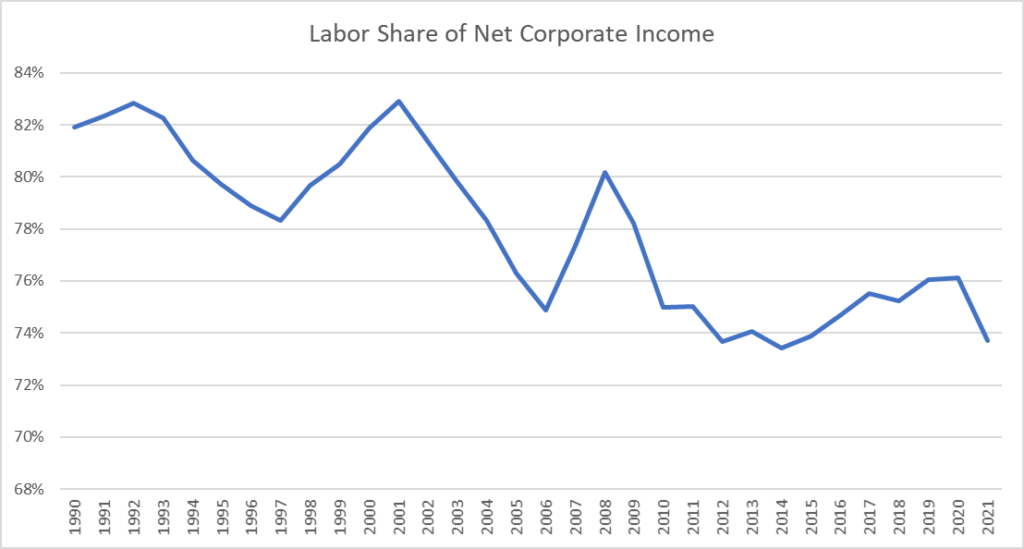
While this was a story that plausibly fit the data in the 1970s, it is very hard to make the wage-price spiral fit the current situation for a simple reason: The wage share of income has fallen sharply since the pandemic. By wage share I mean total compensation to workers, including fringe benefits, not just cash wages and salaries.
Here's the picture:
As can be seen, the wage share of corporate income had been recovering gradually from the troughs it hit in 2014 following the Great Recession.  However, we see a sharp reversal in 2021, with the wage share falling from 76.1% to 73.7%, a decline of 2.4 percentage points.
Perhaps some economists can tell a story where rapid wage growth is driving inflation even as the wage share of income is falling, but I'm not that good an economist. [Editor's Note: "Good" as in dishonest.]

This still looks to me like a case where supply-side disruptions, associated with the economy reopening from the pandemic together with the war in Ukraine are driving inflation.

This view is consistent with the fact that year-over-year inflation in the European Union was 7.5% as of March. The EU countries did not have as big a stimulus as the United States and by most measures the EU labor market is not as tight as in the United States.


--
June Zaccone
National Jobs for All Network
http://www.njfac.org

--
This list is only for announcements, so you may not post. To contact the list manager, write to junez [at] njfac.org
---
You received this message because you are subscribed to the Google Groups "goodjobs" group.
To unsubscribe from this group and stop receiving emails from it, send an email to goodjobsforall+unsubscribe@googlegroups.com.
To view this discussion on the web visit https://groups.google.com/d/msgid/goodjobsforall/CAPV%3DhmBVNmzRKaMENJq_rnGC%3D12-E2eky9qNqE4Nq3kqyAovpw%40mail.gmail.com.

Wednesday, March 23, 2022

[NJFAC] Wall Street Bonuses Have Soared 1,743% Since 1985


Jaw-Dropping': Wall Street Bonuses Have Soared 1,743% Since 1985

A new analysis out Wednesday estimates that if the federal minimum wage had grown at the same rate as Wall Street bonuses over the past three and a half decades, it would currently be $61.75 an hour instead of $7.25.

According to fresh data from the New York State Comptroller, the average bonus dished out to Wall Street employees jumped 20% to a record $257,500 in 2021 as big banks reported huge profits despite widespread havoc caused by the coronavirus pandemic. Last year's average Wall Street bonus was the highest since 2006, prior to the Great Recession.

The comptroller's office points out that while the securities industry comprises just 5% of private-sector employment in New York City, it makes up one-fifth of total private-sector wages.
Taking the new figures into account, Sarah Anderson of the Institute for Policy Studies notes in a report that the average Wall Street bonus has soared by 1,743% since 1985.

"By contrast, typical American workers lost earnings power in 2021," Anderson writes, noting that high inflation has eroded the modest wage gains seen by ordinary people. "Average weekly earnings for all U.S. private-sector employees rose by only 2% between January 2021 and January 2022, according to the Bureau of Labor Statistics."....


--
June Zaccone
National Jobs for All Network
http://www.njfac.org

--
This list is only for announcements, so you may not post. To contact the list manager, write to junez [at] njfac.org
---
You received this message because you are subscribed to the Google Groups "goodjobs" group.
To unsubscribe from this group and stop receiving emails from it, send an email to goodjobsforall+unsubscribe@googlegroups.com.
To view this discussion on the web visit https://groups.google.com/d/msgid/goodjobsforall/CAPV%3DhmD2jXDRTgKuyLuCoCKdjGX_WczcFNBX7fdBoaXPeG19LQ%40mail.gmail.com.

Tuesday, March 8, 2022

[NJFAC] New Treasury Report: Corporate Concentration, Anti-competitive Practices Have Stifled Wages for Workers

A Biden administration report says collusion and other constraints on competition hold down pay and prospects in the labor market.

The report, released Monday by the Treasury Department, contends that employers often face little competition for their workers, allowing them to pay substantially less than they would otherwise.

"There is a recognition that the idea of a competitive labor market is a fiction," said Ben Harris, assistant Treasury secretary in the office of economic policy, which prepared the report. "This is a sea change in economics."....

The Treasury report lays out the many ways in which employers do this. There are noncompete agreements that bar workers from moving to a competitor, and nondisclosure agreements that keep them from sharing information about wages and working conditions — critical information for workers to understand their options. Some companies make no-poaching deals.....

--
June Zaccone
National Jobs for All Network
http://www.njfac.org

--
This list is only for announcements, so you may not post. To contact the list manager, write to junez [at] njfac.org
---
You received this message because you are subscribed to the Google Groups "goodjobs" group.
To unsubscribe from this group and stop receiving emails from it, send an email to goodjobsforall+unsubscribe@googlegroups.com.
To view this discussion on the web visit https://groups.google.com/d/msgid/goodjobsforall/CAPV%3DhmCqRj%2BYp5JzZCBuXC3Z9qonu_N75ym_rd0Dz_R8etXPxQ%40mail.gmail.com.

Sunday, December 5, 2021

[NJFAC] The Great Escape: Why workers are quitting their jobs

The most vulnerable people in America have started the closest thing we've seen in a century to a general strike.
....
This trend has been characterized as the Great Resignation, and just about every economist and pundit has taken their crack at teasing out why it's happening. Explanations have included health and safety fears, child care needs, a tight labor market, boosted savings from stimulus funds or reduced ability to spend money on bars and movies, enhanced unemployment benefits, increases in business formation, desire to work from home, early retirements, restrictions on immigration, demographic shrinking of the prime-age workforce, and my personal favorite, expectations of a labor shortage creating a labor shortage.
Some of these ideas have merit, though none can quite explain everything. In these moments, it's best to actually ask the workers themselves. I did that, talking to dozens of people who have recently quit their job, or experts who closely track workers who have. And some patterns emerged.
The most vulnerable people in America have started the closest thing we've seen in a century to a general strike.
Work at the low end of the wage scale has become ghastly over the past several decades. With no meaningful improvements in federal labor policy since the 1930s, employers have accrued tremendous power. Workers were afraid to voice any disapproval, taking whatever scraps they could get. "The U.S. needs a reset, needs a big push, to get to a place where work is more secure and livable for a lot of the population," said MIT economist David Autor, who has tracked the misery of American deindustrialization and the shock of China's rise as a manufacturing powerhouse.

The pandemic functioned as that reset, creating a mental escape hatch from the immiseration and even danger of ordinary work. If you call someone an "essential worker" for long enough, they start to believe it. They start to wonder whether they deserve more, given their essential nature. Gaining courage from social media, the most vulnerable people in America have started the closest thing we've seen in a century to a general strike.

For now, it's working to deliver higher wages and better conditions. But from my talks with workers, they're really seeking something more ineffable than a couple more bucks an hour. Work is the largest time block of the day, in a moment where we've all learned how precious time can be. People simply want to spend that time getting the dignity and respect denied to them for so long.....

--
June Zaccone
National Jobs for All Network
http://www.njfac.org

--
This list is only for announcements, so you may not post. To contact the list manager, write to junez [at] njfac.org
---
You received this message because you are subscribed to the Google Groups "goodjobs" group.
To unsubscribe from this group and stop receiving emails from it, send an email to goodjobsforall+unsubscribe@googlegroups.com.
To view this discussion on the web visit https://groups.google.com/d/msgid/goodjobsforall/CAPV%3DhmC92_Yri457_HpE1eKG51oiaL6yhCAexY8Mrbrkh%2ByN8Q%40mail.gmail.com.

Saturday, October 2, 2021

[NJFAC] fw: [URPE] Invitation to the Global Forum on Democratizing Work, Oct 5-7, 2021

-----Original Message-----
From: Pavlina Tcherneva via URPE-Announcements <urpe-announcements@lists.csbs.utah.edu>
To: urpe-announcements@lists.csbs.utah.edu
Sent: Wed, Sep 29, 2021 10:46 pm
Subject: [URPE] Invitation to the Global Forum on Democratizing Work, Oct 5-7, 2021

Dear Colleagues,
Please join us at the first Global Forum on Democratizing Work, October 5-7, 2021, so-organized by the Open Society University Network (OSUN) Economic Democracy Initiative (EDI) at Bard College. The Global Forum builds on the momentum generated by last year's Democratizing Work manifesto, which was published in more than 43 newspapers, in 27 languages, and in 36 countries around the world.

This year, the online Global Forum brings together over 380 speakers and 100 panels in 9 languages from all continents (except Antarctica) in a one-of-a-kind conversation. Each day focuses on one of the manifesto's three principles: democratizing the workplace, decommodifying work and securing the right to decent employment, and decarbonizing the planet and tackling climate change.

Featuring voices from academia, trade unions, progressive members of the business community, public sector representatives, environmental activists, human rights organizations, and journalists, the Global Forum is a worldwide event transcending conventional academic conferences.

The event is free and open to the public. Please share it with your students and register here: https://hopin.com/events/global-forum-on-democratizing-work
Confirmed participants include:
Elizabeth Anderson  —  University of Michigan
Kate Aronoff  —  The New Republic
June Carbone  —  University of Minnesota Law School
Raúl Carrillo — Yale Law School
Daniel Aldana Cohen  —  University of California, Berkeley
Daniela Gabor  —  University of the West of England, Bristol (United Kingdom)
Jayati Ghosh  —  University of Massachusetts, Amherst; United Nations
Rohan Grey — Willamette University
Robin Hahnel  —  American University
Jason Hickel  —  Royal Society of Arts (United Kingdom)
Tim Jackson  —  University of Surrey (United Kingdom)
Fadhel Kaboub  —  Denison University
Aurore Laluq   —  European Parliament
Iñigo Albizuri Landazabal  —  Global Head of Public Affairs, Mondragon Corporation (Spain)
Natan Last  —  The New Yorker
Achile Mbembe  —  University of the Witwatersrand (South Africa)
Sara Nelson  —  Association of Flight Attendants, AFL-CIO
Yeva Nersisyan  —  Franklin & Marshall College
Carole Pateman  —  University of California, Los Angeles
Sanjukta Paul  —  Wayne State University
Thomas Piketty  —  Paris School of Economics (France)
Katharina Pistor  —  Columbia University
Dani Rodrik  —  Harvard University
Juliet Schor  —  Boston College
David P. Stein  —  University of California, Los Angeles
Ndongo Sylla  —  Rosa Luxemburg Foundation (Senegal)
Olúfẹ́mi O. Táíwò  —  Georgetown University
Zdravka Todorova  —  Wright State University
Charles Whalen  —  Baldy Center for Law and Social Policy, University at Buffalo
A. Erinç Yeldan  —  Kadir Has University (Turkey) 
and many more.

Full program, registration, and a list of speakers here:

--
Pavlina R. Tcherneva
Associate Professor of Economics, Bard College
Director, OSUN Economic Democracy Initiative
Research Scholar, Levy Economics Institute
Annandale-on-Hudson, NY 12504
_______________________________________________

This is the listserve of the Union for Radical Political Economics (URPE), an interdisciplinary association devoted to the study, development and application of radical political economic analysis to social problems. See www.urpe.org. It is a moderated, low volume listserve and any opinions expressed are those of the message's author, not of URPE as an organization.

Please submit messages, exactly as you would like them to read, to:
urpe-announcements@lists.csbs.utah.edu
Messages should be short and attachments cannot be included.


--
June Zaccone
National Jobs for All Network
http://www.njfac.org

--
This list is only for announcements, so you may not post. To contact the list manager, write to junez [at] njfac.org
---
You received this message because you are subscribed to the Google Groups "goodjobs" group.
To unsubscribe from this group and stop receiving emails from it, send an email to goodjobsforall+unsubscribe@googlegroups.com.
To view this discussion on the web visit https://groups.google.com/d/msgid/goodjobsforall/CAPV%3DhmCvkYX5S6wM9fBi5SaVRDZCQwC6vRga34Qqea9dT9LvRg%40mail.gmail.com.

Tuesday, September 28, 2021

[NJFAC] Good Jobs for All Virtual Town Hall Meeting


New Haven, CT - Discussion of Employment, Health Care andSocial, Economic, and Environmental JusticeWednesday, September 29, 2021, at 7 PM
View this email in your browser
National Jobs for All Network
_______________________________________________________________________
P.O. Box 96, Lynbrook, NY 11563 · njfan@njfac.org · www.njfac.org 
Virtual Town Hall Meeting, September 29, 2021
Email Email
Facebook Facebook
LinkedIn LinkedIn
Twitter Twitter


  New Haven, CT

Good Jobs for All Virtual Town Hall Meeting
Discussion of Employment, Health Care and
Social, Economic, and Environmental Justice
Wednesday, September 29, 2021, at 7 PM

Free to attend and open to all. Register here.

 
Dr. Phil Harvey
Professor of Law and Economics at Rutgers Law School
Philip Harvey is a human rights economist and one of the world's foremost authorities on the right to work. In recent years he worked closely with Rep. John Conyers, designing and drafting legislation that would guarantee this right in the United States, as advocated by President Franklin D. Roosevelt over 70 years ago. Dr. Harvey advised Rep. Conyers on the design and drafting of H.R. 1000 ("The Humphrey-Hawkins 21st Century Full Employment and Training Act"). He is a founding member of the National Jobs for All Network.

Professor Harvey received his B.A. degree from Yale University, his Ph.D. in economics from the New School for Social Research, and his J.D. from Yale Law School.
 
Aziz Dehkan
Connecticut Roundtable on Climate and Jobs  
Rosana G. Ferraro
Social Welfare Action Alliance, Connecticut Chapter
Holly Hackett
Medicare For All CT; 
Greater New Haven Coalition for People 
Kim Hart
Witnesses To Hunger
Dr. Henry Lowendorf
Greater New Haven Peace Council
Frank Panzarella
Labor History Association Troubadour; Union Leader & Organizer: Local 1990 International Association of Machinists
Senator Gary Winfield
CT State Senator 10th District - New Haven
Manuel Camacho
Youth President, Ice the Beef, Junior at Hillhouse High School
Dr. Trudy Goldberg
Chair, National Jobs For All Network  
Sarianna Sabbarese
SCSU Graduate Depts. of Social Work & Women's and Gender Studies
Host Dr. Stephen Monroe Tomczak
Professor of Social Welfare Policy and Community Organization, Southern Connecticut State University Department of Social Work


Sponsors

National Jobs For All Network
Social Welfare Action Alliance - CT Chapter (SWAA-CT)
SCSU - Rapid Response Team (RRT)
SCSU Social Work Department
The Greater New Haven Peace Council
CT Roundtable on Climate and Jobs
HUSKY 4 Immigrants Campaign
Witnesses To Hunger - New Haven
 
Contact: Sarianna Sabbarese at ssabbarese@gmail.com

Get Involved!


Join! Donate! Subscribe!


The National Jobs for All Network is dedicated to the proposition that meaningful employment is a precondition for a fulfilling life and that every person capable of working should have the right to a job. As part of our mission, the NJFAN promotes discussion, encourages networking, and disseminates information concerning the problem of unemployment, the struggle for workers' rights, and the goal of guaranteeing decent work for everyone who wants it.

NJFAN relies on your support. If you find our material useful, please make a tax-deductible donation. We are all volunteers, except for a part-time coordinator and a part-time administrator.

We are publishing this newsletter to provide a public forum where the multiple groups and countless individuals interested in promoting this goal can learn what others are doing to promote the jobs guarantee idea, build public support for it, and pursue legislative initiatives to implement it.

We invite our readers to:
  • Help us establish a Jobs for All Action clearinghouse by informing us of publications, actions, and events that promote a jobs guarantee and related economic justice goals to share the information with other readers
  • Comment on the contents of this issue of the Jobs for All Newsletter
  • Submit ideas for articles in coming issues of the Jobs for All Newsletter
  • Provide names and email addresses of individuals to whom we may send subsequent issues of the Jobs for All Newsletter.
Please send your updates and contact suggestions to njfan@njfac.org. Thanks so much in advance for your help in building this important social movement.

The views expressed in the articles published in the Jobs for All newsletter (including those authored by editors and writers of the newsletter and board members of the NJFAN) are not necessarily those of the NJFAN as an organization. We hope that the newsletter will become a forum of discussion and debate among jobs-for-all/full-employment/right-to-work/job-guarantee advocates. With that goal in mind, we plan to add a letter to the editor section to the newsletter and also encourage readers to email us at newsletter@njfac.org to suggest articles they would like to contribute to the newsletter. We promise a quick response.

Newsletter Committee
Trudy Goldberg (editor); Chuck Bell and Charlotte Wilhelm (production managers); Frank Stricker; Philip Harvey; Stephen Monroe Tomczak (Movement News); Logan Martinez; June Zaccone (Full Count and NJFAN website) and Noreen Connell.

National Jobs for All Network
P.O. Box 96
Lynbrook, NY 11563
203-856-3877
Web: www.njfac.org
Email: njfan@njfac.org
Website
Facebook
LinkedIn
Twitter
Copyright © 2021 National Jobs for All Network, All rights reserved.
You are receiving this email because you have signed up to get occasional updates and information from the National Jobs for All Coalition.

Our mailing address is:
National Jobs for All Network
PO Box 96
Lynbrook, NY 11563

Add us to your address book


Want to change how you receive these emails?
You can update your preferences or unsubscribe from this list.

Email Marketing Powered by Mailchimp
--
June Zaccone
National Jobs for All Network
http://www.njfac.org

--
This list is only for announcements, so you may not post. To contact the list manager, write to junez [at] njfac.org
---
You received this message because you are subscribed to the Google Groups "goodjobs" group.
To unsubscribe from this group and stop receiving emails from it, send an email to goodjobsforall+unsubscribe@googlegroups.com.
To view this discussion on the web visit https://groups.google.com/d/msgid/goodjobsforall/CAPV%3DhmDH3uzSBELOZyerQRqeGKc5NHH2C6tqMyyYb5UZbsA6bQ%40mail.gmail.com.