Saturday, February 23, 2019

[NJFAC] 'Why Cities Should Stop Playing Amazon's Game"

Are you worried about all those jobs New York City lost when Amazon walked away?  Here is an article with many links that will put your mind to rest.

--
This list is only for announcements, so you may not post. To contact the list manager, write to njfac [at] njfac.org
---
You received this message because you are subscribed to the Google Groups "goodjobs" group.
To unsubscribe from this group and stop receiving emails from it, send an email to goodjobsforall+unsubscribe@googlegroups.com.
For more options, visit https://groups.google.com/d/optout.

Wednesday, January 23, 2019

[NJFAC] Left-Behind Rurals: Some Facts, Many Questions

Left-Behind Rurals: Some Facts, Many Questions                                         by Frank Stricker
            Job totals keep increasing in this long economic recovery and the unemployment rate has stayed under 4% for awhile. But there are not enough jobs for everyone who needs a job, and certainly not enough good ones. This is especially true for many poor and neglected urban neighborhoods and rural communities. More  jobs in the national total does not do enough to relieve employment and poverty problems in many of these areas.
            Because not enough jobs are reaching depressed communities, targeted direct-job creation is essential. Among large-scale proposals is the Humphrey-Hawkins 21st Century Full Employment and Training Act, which people in National Jobs for All Network helped to write. It has had several dozen sponsors in the House of Representatives. The proposed legislation uses federal funds to pay for jobs in government and non-profits. It is not limited to city populations, but it may work best in areas where there are many jobless persons and which are near employers who can later offer participants regular jobs. There is also a major proposal by UC Irvine economist David Neumark. It is urban-oriented.  Neumark's proposal includes a thorough demolition of job-creation efforts that rely on tax incentives for capitalist investors. (There's such a program in the 2017 Republican tax-cut legislation.) The key to both proposals is the recognition that decent jobs won't get to where they are needed unless the federal government funds them.
            There are scholars and also emigrants from rural America who believe that not much can be done or should be done to save depressed rural areas. Some such areas aren't economically viable. Some nourish nasty values. One person recalls "up-the-holler" villages reeking with self-righteousness, aggressive racism, and willful ignorance. There is a dark side to life in some small towns. But remember also that millions of rural people are African Americans, Hispanics, and Native Americans--groups that have higher poverty and jobless rates than rural whites.
            Right now there aren't many compelling big-bang proposals for creating permanent jobs in low-population areas. In most cases, there is little reason for private investors to locate in such areas. And apparently they haven't. The decade-long economic recovery from the Great Recession has not helped. In the early 1990s recovery period, 71% of new businesses in America were in counties with fewer than 500,000 people; in the recovery from the Great Recession, just 19%. In many counties with even smaller populations, there has been no net growth in the number of business firms in recent years.
            Traditional approaches won't help much. With exceptions that include solar and other green manufacturing, factory employment is unlikely to grow much in country towns. Also, many kinds of farming are becoming less labor-intensive. Coal mining is not going to make a big comeback in Appalachia; and it is a moral abomination that President Trump says otherwise.  Appalachian coal is not economically viable in the long run; black lung disease is attacking miners at younger ages than ever; and coal-burning is a leading cause of global warming.
            Ecological restoration projects may be a good idea for areas ravaged by mineral extraction. And what about new tech jobs? Entrepreneur Ankur Gopal and a couple of politicians have brought a handful of good tech jobs to a severely depressed coal area of Eastern Kentucky. Whether that effort can be enlarged and replicated elsewhere is uncertain. Rural areas may need access to high-speed internet, and they should have it. But will new businesses and enough good jobs follow? Entrepreneurs who want companies that innovate tend to believe that innovation thrives where there are large agglomerations of skilled workers, and proximity to transportation, as well as restaurants, theaters, and other things that make educated workers happy.
            There are experts who say that the best thing we can do for the rural poor is help them leave town. Governments can offer moving subsidies. A utopian suggestion is to increase the amount of affordable housing units in San Francisco, New York, and other cities, and thus provide a stronger incentive to get people away from rural America. Some observers suggest that we strengthen small cities, such as Rockford, Illinois, and build links between such cities and the rural communities that can be part of their economic networks.
            Any program to lift people in some rural districts has to lift wages. Solving poverty cannot be done by maintaining a sub-poverty federal minimum wage. The federal minimum wage should be put on the road to $15, as House Democrats have now proposed. It's true, some establishments may shut down. That they cannot support a living wage is a reasons why government has to step in
            Is rural America hostile to big government? Some of its inhabitants may be, but quite a few of them are hooked on government assistance. Can they be helped to face reality? Elites in poor southern states in the south have been happy with the kind of state socialism that brought a lot of military installations. Why not socialism focused on civilian projects? If the private sector cannot supply a living wage, government should do it, directly or indirectly. In a way it's already happening, but not in mines and factories. Educational, health and social service establishments--some of them governmental or non-profit--are already the single largest employing group in the 704 entirely rural counties in America.  
            Many southern Republican governors don't seem to care much about poor people. I could be wrong. While popular support for Obamacare provisions is growing, southern governments are active in the campaign against the Obamacare-Medicaid expansion, and some are imposing phony work requirements to keep poor people from getting assistance. That won't help people who cannot afford health insurance, or opioid and heroin addicts who need a lot of help. And those who resist Obamacare are fighting to limit a sector that is always adding new jobs. Of 86 rural hospitals that have closed in America since 2010, most are in southern states that have not expanded Medicaid coverage.
 
Frank Stricker is on the board of NJFAN and emeritus professor of history and labor studies at California State University, Dominguez Hills. He is finishing What Ails the American Worker? Unemployment and Crummy Jobs: History, Explanations, Remedies.
 
Questions and comments welcome. Some useful readings that helped me:
 
Arnosti, Nathan, and Amy Liu, "Why Rural America Needs Cities," November 30, 2018, Brookings Institution.
 
Guzman, Gloria, et al., at the United States Census Bureau's Income Statistics and Poverty Statistics Branches, "Poverty Rates Higher, Median Household Income Lower in Rural Counties Than in Urban Areas," December 6, 2018.
 
Hochschild, Arlie, "Silicon Holler: A Bipartisan Effort to Revitalize the Heartland, One Tech Job at a Time," New York Times, Sunday Review, September 23, 2018.
 
"How Medicaid Work Requirements Will Harm Rural Residents--and Communities," Center for Budget and Policy Priorities, August 22, 2018.
 
Jarvie, Jenny, "Black Lung, Grim Future for Younger Miners," Los Angeles Times, December 26, 2018.
 
Kirby, Brendan, "Alabama's Poorest: Almost Half of All Income in Wilcox County Comes from Uncle Sam," February 13, 2014, Alabama Media Group at al.com.
 
Neumark, David, "Rebuilding Communities Job Subsidies," 71-121, in Shamburg and Nunn, eds., Place-Based Policies for Shared Economic Growth ((2018)
 
Volcovici, Valerie, "Awaiting Trump's Coal Comeback, Miners Reject Training," November 1, 2017, at Reuters.com.
 
Porter, Eduardo, "Abandoned America, The Hard Truths of Trying to Bring Jobs Back to Small Towns," New York Times, Sunday Review, December 16, 2018; and Rachel Harris and Lisa Tarchak, "Small Town America is Dying. How Can We Save It?" (Readers Talk Back), December 23, 2018.

--
This list is only for announcements, so you may not post. To contact the list manager, write to njfac [at] njfac.org
---
You received this message because you are subscribed to the Google Groups "goodjobs" group.
To unsubscribe from this group and stop receiving emails from it, send an email to goodjobsforall+unsubscribe@googlegroups.com.
For more options, visit https://groups.google.com/d/optout.

Tuesday, January 22, 2019

[NJFAC] Meritocracy, What Meritocracy

Ian Welsh Meritocracy, What Meritocracy


Posted: 11 Dec 2018 
So, unless you think that genetic potential is that unequally distributed (and can explain eras where this chart did not apply, as in the post-WWII decades), you can pretty much forget "meritocracy."
Meritocracy is just a way of saying "we test for the things the middle and upper class has the resources to prepare for their children." And that's before we get to the extra opportunities having wealthier parents gives one simply from network effects.
Fairness and justice are obviously big issues, but just as bad is that many of these people might contribute in a huge way, and are never given the opportunity.
Stephen Jay Gould once said:
"I am, somehow, less interested in the weight and convolutions of Einstein's brain than in the near certainty that people of equal talent have lived and died in cotton fields and sweatshops."
These days, McDonalds, Walmarts and Amazon warehouses..

The results of the work I do, like this article, are free, but food isn't, so if you value my work, please DONATE or SUBSCRIBE.

livery powered by Google

--
June Zaccone
National Jobs for All Coalition
http://www.njfac.org

--
This list is only for announcements, so you may not post. To contact the list manager, write to njfac [at] njfac.org
---
You received this message because you are subscribed to the Google Groups "goodjobs" group.
To unsubscribe from this group and stop receiving emails from it, send an email to goodjobsforall+unsubscribe@googlegroups.com.
For more options, visit https://groups.google.com/d/optout.

Friday, December 14, 2018

[NJFAC] What’s Under That Amazon Tank?


What's Under That Amazon Tank?
 
            If you shop much on Amazon, you know that the selection is incredible, it's easy to press the buy-button, and, if you have Amazon Prime, things come really fast to your house and oft- times with free delivery. I bought something the other day and it arrived in less than a day. Thus the bright side of the Amazon phenomenon.
            But even and perhaps especially in a holiday shopping season, it's good to think about the dark underside of the Amazon tank that is rolling over businesses, cities desperate for distribution centers and headquarters, and the people who labor in the warehouses or drive for delivery services, but don't earn a living wage.
            A smart piece that focuses on Amazon's effort to gain monopolistic control of the whole  retail market is Stacy Mitchell's piece, "The Empire of Everything." It appeared last March in The Nation. Mitchell writes about the company's predatory pricing practices, ruthless dealings with recalcitrant businesses, and its contribution to the world of crummy jobs and greater income inequality. It's fun to buy on Amazon, but not so much when you think about these things. And especially not when you think that with every purchase we are helping to enrich Amazon chief Jeff Bezos. He is already the richest man in America and probably in the world. He really a monopolizer in the mold of oil baron John D. Rockefeller, but he's worse. Bezos wants to squeeze all retail commerce through the Amazon pipeline.
 
 
Posted by Frank Stricker, NJFAC board member

--
This list is only for announcements, so you may not post. To contact the list manager, write to njfac [at] njfac.org
---
You received this message because you are subscribed to the Google Groups "goodjobs" group.
To unsubscribe from this group and stop receiving emails from it, send an email to goodjobsforall+unsubscribe@googlegroups.com.
For more options, visit https://groups.google.com/d/optout.

Tuesday, November 20, 2018

[NJFAC] Trying Again for Full Employment

Trudy Goldberg's article, "Trying Again for Full Employment," was published as the lead article in Dollars and Sense.

"As prominent progressives talk up a federal job guarantee, what can we learn from earlier attempts to legislate full employment?"

Goldberg is chair of the National Jobs for All Coalition, :


--
June Zaccone
National Jobs for All Coalition
http://www.njfac.org

--
This list is only for announcements, so you may not post. To contact the list manager, write to njfac [at] njfac.org
---
You received this message because you are subscribed to the Google Groups "goodjobs" group.
To unsubscribe from this group and stop receiving emails from it, send an email to goodjobsforall+unsubscribe@googlegroups.com.
For more options, visit https://groups.google.com/d/optout.

Tuesday, November 6, 2018

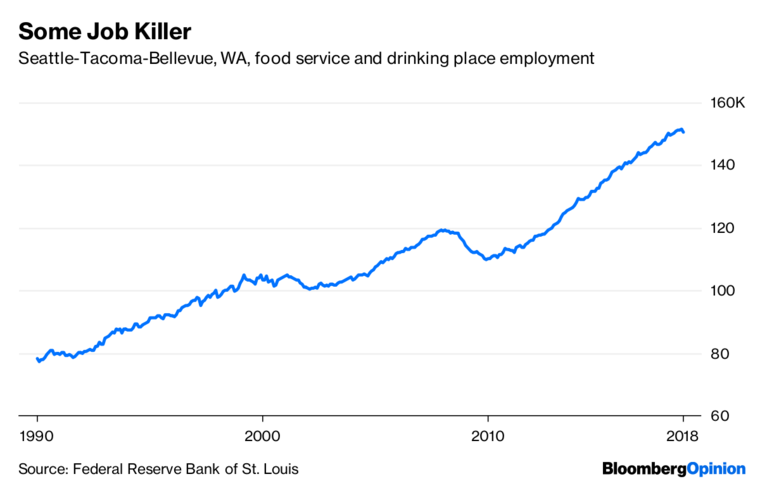
[NJFAC] Economists admit that $15 Seattle minimum wage was largely beneficial, reverse claims

Earlier this year, a group of business school researchers from the University of Washington and NYU, as well as Amazon, published an influential paper claiming that the rising Seattle minimum wage had decreased take-home pay for workers by 6% due to cuts to work hours -- the paper was trumpeted by right-wing ideologues as examples of how "liberal policies" hurt the workers they are meant to help.
But a new paper by the same authors (Sci-Hub mirror) shows that the rising minimum wage generated major increases for the workers who had the most hours, whose hours were only cut a little, but still came out ahead thanks to the wage increase; workers with fewer hours saw no financial harm from the rising minimum wage, working fewer hours and bringing home the same sum; and they found some harm to people who had the smallest number of hours) (which may actually reflect stronger demand for workers and fewer workers in this category of very-low-hour work).
The study's authors explain that their findings are all consistent with one another, but people who found methodological flaws in the first study say that the reversal is inevitable. Here's Barry Ritholz (previously) in Bloomberg:....

--
June Zaccone
National Jobs for All Coalition
http://www.njfac.org

--
This list is only for announcements, so you may not post. To contact the list manager, write to njfac [at] njfac.org
---
You received this message because you are subscribed to the Google Groups "goodjobs" group.
To unsubscribe from this group and stop receiving emails from it, send an email to goodjobsforall+unsubscribe@googlegroups.com.
For more options, visit https://groups.google.com/d/optout.

Saturday, October 13, 2018

[NJFAC] Wages Rising? by Frank Stricker

            Some observers write as though we are waiting for wage growth to return to normal. We just need money wages to grow a little more and inflation rates to fall a bit and we'd be back on the right track. But what's normal?  For example, how often since 2000-2017 has the real wage of average employees increased at least 1% a year? In only four of eighteen years: 2001, 2002, 2014, 2015.
            If you want to feel good for five seconds, the latest earnings report shows that real wages for average employees are up since September of 2017. But the increase is just 0.4%--less than a half a percent. That's what we are getting in what is supposed to be a red-hot labor market and a strong economy--so strong that the Federal Reserve is raising interest rates to cool it down.
            So for workers the economy is good but not great, and has been so for years. Basic power structures and institutions lean heavily against the working class. Unions cover few workers. Some states and localities are raising their minimum wages, but many are not doing so, and the federal minimum wage has been stuck at $7.25 for years.
            And while labor markets are good, and causing wage upticks in some places, there is no generalized shortage of labor--nothing dire enough to push up money wages to increase 4 to 5% a year. Employers aren't used to having to expend real effort to get medium to low-skilled workers. When they have to exert, they think it's a labor shortage. But real unemployment is not low enough to give average workers enough individual bargaining power. On the sidelines there are millions of people who are ready to work. The labor force participation rate of prime-age workers (25 to 54 years old) is rising but it's still several points below where it was in the 1990s. Today, some distribution centers, trucking companies, and other businesses have to pay more, but there are plenty of applicants for many job slots across the country. That's one reason why wages haven't risen much. That is why Blue Ridge Health Care in North Carolina can get entry-level certified nursing assistants for $9.50. It's why, over the past year, ZipRecruiter registered 8.1 million applications for 68,500 postings for administrative assistant jobs, and 9.2 million applications for 136,000 warehouse job listings.
            It's true that some employers are having to pay more to get the employees they need. That's one reason Jeff Bezos is raising pay to $15 an hour at Amazon. (Another reason is that it's bad P.R. that Amazon workers are stuck at $12 or $13 whilst Jeff is worth almost two hundred billion dollars.) But that might not be as much of a raise as it seems. What Jeff gives with the left hand, he takes away with the right. The company is pulling back on its bonus and stock programs. Some employees think they will be worse off.
            One final note on $15. Amazon's move reflects what a good thing the $15 minimum goal is. It has been a tremendous rallying point, a unifying force around an ultra-reasonable goal. But it is just the first step. Fifteen dollars looks good because wage growth has been mostly terrible since the early 1970s. But $15 is just $31, 200 for a person who works absolutely full-time, year-round. If you think that amount is adequate, you've been drinking the Cato-Kool-Aid at Republican Congressional parties.

Frank Stricker is on the board of NJFAC and has written What Ails the American Worker? Unemployment and Crummy Jobs: History, Explanations, Remedies.


--
This list is only for announcements, so you may not post. To contact the list manager, write to njfac [at] njfac.org
---
You received this message because you are subscribed to the Google Groups "goodjobs" group.
To unsubscribe from this group and stop receiving emails from it, send an email to goodjobsforall+unsubscribe@googlegroups.com.
For more options, visit https://groups.google.com/d/optout.