Wednesday, May 3, 2023

[NJFAC] WSJ: Why Is Inflation So Sticky? It Could Be Corporate Profits

Why Is Inflation So Sticky? It Could Be Corporate Profits

Some companies might have been raising prices faster than their costs have increased

Inflation has proved more stubborn than central banks bargained for when prices started surging two years ago. Now some economists think they know why: Businesses are using a rare opportunity to boost their profit margins.
....
Inflation rates also remain uncomfortably high in the U.S. and many other parts of the world despite interest-rate rises that have gone further and been delivered more quickly than at any time since the 1980s.

There have been good reasons for businesses to raise their prices in recent months. The supply-chain disruptions caused by the Covid-19 pandemic and the energy, food and raw-material bottlenecks that followed Russia's invasion of Ukraine have pushed costs higher.

But there are signs that companies are doing more than covering their costs.....

But these aren't normal times. In rare situations—such as an economy's reopening after a pandemic—widespread knowledge that costs are rising allows businesses to raise their prices knowing that their competitors will act in the same way, according to a paper by Isabella Weber, assistant professor of economics at the University of Massachusetts, Amherst, and her colleague, Evan Wasner.

That is a pattern the two economists said has played out in an analysis of recent earning calls in which executives at U.S. businesses present their financial results to analysts.

"We do have to think about pricing differently," said Ms. Weber. "A cost shock, or bottlenecks can create an implicit agreement among firms that raise their prices, so they can expect others to act likewise."....


--
June Zaccone
National Jobs for All Network
http://www.njfac.org

--
This list is only for announcements, so you may not post. To contact the list manager, write to junez [at] njfac.org
---
You received this message because you are subscribed to the Google Groups "goodjobs" group.
To unsubscribe from this group and stop receiving emails from it, send an email to goodjobsforall+unsubscribe@googlegroups.com.
To view this discussion on the web visit https://groups.google.com/d/msgid/goodjobsforall/CAPV%3DhmB_rMVhYEjX1kSXXSTD2vrHRmuAH6Ujr4X81DsGbJSh3Q%40mail.gmail.com.

Sunday, April 23, 2023

[NJFAC] Racial Disparities in Unemployment Insurance

Racial Differences in Unemployment Insurance

There are many racial disparities in employment - and  Elizabeth Ananat (Barnard) and Anna Gassman-Pines (Duke) find racial disparities for those who have lost their jobs as well, as reported in our newest EconoFact memo, Racial Differences in Unemployment Insurance. These results are based on their ongoing survey of hourly service workers in Philadelphia.  Not only were a higher proportion of Black and Hispanic workers laid off as compared to White workers, a smaller proportion of these unemployed workers received unemployment insurance (UI).  Their research finds:  

  • Only one-third of the surveyed Black and Hispanic laid-off service workers received UI and the legislated supplement in a timely manner as compared to more than half of White workers.
  • There were more leakages in every stage of the process of applying for, and receiving, UI for Black and Hispanic workers as compared to White workers. These workers were less likely to apply for UI and those who applied were less likely to receive these benefits, including the special supplemental benefits available during the pandemic.
  • There is a range of reasons for these disparities, including complicated bureaucratic processes, outdated state UI systems, and employers blocking UI claims differentially by race and ethnicity.
  • Liz and Anna also report on the adverse consequences to the unemployed because of a lack of access to UI that include material hardship and worsened mental health.  These occurred across all racial and ethnic groups, but Black and Hispanic workers suffered proportionally more because of their relatively lower access to UI.  

Liz and Anna began this survey in the Fall of 2019. In an earlier EconoFact memo from 2021, Liz and Anna's report results from the survey that document the burdens families faced from frequent, unexpected disruptions in childcare and schools during the pandemic.

--

June Zaccone
National Jobs for All Network
http://www.njfac.org

--
This list is only for announcements, so you may not post. To contact the list manager, write to junez [at] njfac.org
---
You received this message because you are subscribed to the Google Groups "goodjobs" group.
To unsubscribe from this group and stop receiving emails from it, send an email to goodjobsforall+unsubscribe@googlegroups.com.
To view this discussion on the web visit https://groups.google.com/d/msgid/goodjobsforall/CAPV%3DhmDjZgzRfB7p4zLsitqG5SMawegMddVJa0uQ5Vi4gJt2hQ%40mail.gmail.com.

Wednesday, March 29, 2023

[NJFAC] Pollin: Fossil Fuel Industry Phase-Out and Protecting Workers’ Living Standards

ed, Mar 29, 2023 at 11:31 AM

Fossil Fuel Industry Phase-Out and Just Transition: Designing Policies to Protect Workers' Living Standards

by: Robert PollinFebruary 14, 2023 |

Abstract
This paper focuses on just transition policies targeted at supporting workers now employed in the fossil fuel industries and ancillary sectors within high-income economies. As a general normative principle, I argue that the overarching aim of such policies should be to protect workers against major losses in their living standards resulting through the fossil fuel industry phase-out. The impacted workers should be provided with three critical guarantees to accomplish this, in the area of jobs, compensation and pensions. Just transition policies should also support workers in the areas of job search, retraining and relocation, but these forms of support should be understood as supplementary. Within the framework of these broad principles, the paper first reviews experiences with transitional policies in Germany, the UK, the EU and, more briefly, Japan and Canada. A critical point that emerges is that these just transition policies do not provide the needed guarantees for assuring workers that they will not experience major living standard declines. The paper then describe an illustrative just transition program for workers that includes reemployment, income and pension guarantees, focusing on a case study for the U.S. state of West Virginia. The results show that the costs of the just transition program for West Virginia's fossil fuel industry dependent workers will amount to an annual average of about $42,000 per worker, equal to about 0.2 percent of West Virginia's GDP. I briefly summarize results from the seven other studies of U.S. states and for the overall U.S. economy. For the U.S. economy overall, the just transition program's costs would total to about 0.015 percent of GDP. These findings demonstrate that providing a generous just transition program does not entail unaffordable levels of public spending. Robust just transition policies should therefore be understood as an entirely realistic prospect for all high-income economies.


--
June Zaccone
National Jobs for All Network
http://www.njfac.org

--
This list is only for announcements, so you may not post. To contact the list manager, write to junez [at] njfac.org
---
You received this message because you are subscribed to the Google Groups "goodjobs" group.
To unsubscribe from this group and stop receiving emails from it, send an email to goodjobsforall+unsubscribe@googlegroups.com.
To view this discussion on the web visit https://groups.google.com/d/msgid/goodjobsforall/CAPV%3DhmBPa54QLAGrTRL%3DiV_CdfA2KZm80-mLe4EJxJG%2B3SyioA%40mail.gmail.com.

Monday, March 27, 2023

[NJFAC] why a higher minimum wage is resisted by employers already paying it

"Everyone Wants A Raise When The Minimum Wage Goes Up"

Mar 27, 2023 • Julia Rock
Lobbyists opposing a minimum wage hike in New York say the quiet part out loud behind closed doors.
  Twenty dollar bills being counted. (AP Photo/Elise Amendola, File)
The corporate lobbying group fighting a New York state effort to raise the minimum wage has publicly argued that an increase will throw more than a hundred thousand people out of work. But behind closed doors last week, the lobbying group claimed many of its members are already paying their lowest-paid workers more than the state minimum wage.

"I think the message that a lot of small businesses have been trying to send is that… a lot of businesses are paying well above the minimum wage because of the labor shortage right now," said Ashley Ranslow, the New York state director of the National Federation of Independent Business (NFIB), the lobbying group hosting the call.
The real problem, Ranslow said, is that "everyone wants a raise when the minimum wage goes up," which creates "a spiraling and compounding effect for small businesses."

It's a remarkable admission from one of the main corporate lobbying groups fighting the legislative effort to increase New York's minimum wage — and directly contradicts her organization's public line.

"This is so typical — [NFIB is] 'Chicken Little' every time there's a proposal to raise the wage," said Paul Sonn, state policy director for the National Employment Law Project, which is backing the minimum wage increase. "But even they know the sky isn't falling. They're saying the quiet part out loud, admitting that the minimum wage is irrelevant right now, it's far too low, and would have to be an awful lot higher before it actually starts to have an impact."....


--
June Zaccone
National Jobs for All Network
http://www.njfac.org

--
This list is only for announcements, so you may not post. To contact the list manager, write to junez [at] njfac.org
---
You received this message because you are subscribed to the Google Groups "goodjobs" group.
To unsubscribe from this group and stop receiving emails from it, send an email to goodjobsforall+unsubscribe@googlegroups.com.
To view this discussion on the web visit https://groups.google.com/d/msgid/goodjobsforall/CAPV%3DhmDS7J%2BXvVZ2TsEnn8LmM4Ho3OnpGryXYBwHGdFpPwp0JQ%40mail.gmail.com.

Saturday, March 11, 2023

[NJFAC] Jobs for All Newsletter, February 2023

Jobs for All Newsletter, February 2023 New Version of HR 1000;  Connecticut Considers Full Employment Trust Fund Bill;  National Infrastructure Bank;  Looking Back at the National Youth Administration

--
June Zaccone
National Jobs for All Network
http://www.njfac.org

--
This list is only for announcements, so you may not post. To contact the list manager, write to junez [at] njfac.org
---
You received this message because you are subscribed to the Google Groups "goodjobs" group.
To unsubscribe from this group and stop receiving emails from it, send an email to goodjobsforall+unsubscribe@googlegroups.com.
To view this discussion on the web visit https://groups.google.com/d/msgid/goodjobsforall/CAPV%3DhmA4iyO7nVBjGF%3D-LSfsVhu3c19TaE-001PE_RH%3DsX4sqA%40mail.gmail.com.

Friday, March 3, 2023

[NJFAC] low unemployment means more employment for those with a disability


--
June Zaccone
National Jobs for All Network
http://www.njfac.org

--
This list is only for announcements, so you may not post. To contact the list manager, write to junez [at] njfac.org
---
You received this message because you are subscribed to the Google Groups "goodjobs" group.
To unsubscribe from this group and stop receiving emails from it, send an email to goodjobsforall+unsubscribe@googlegroups.com.
To view this discussion on the web visit https://groups.google.com/d/msgid/goodjobsforall/CAPV%3DhmDGaEUbibsdxa9or9WwmvHtY8K-bgFaLK9K8-KF%3D%2B3dww%40mail.gmail.com.

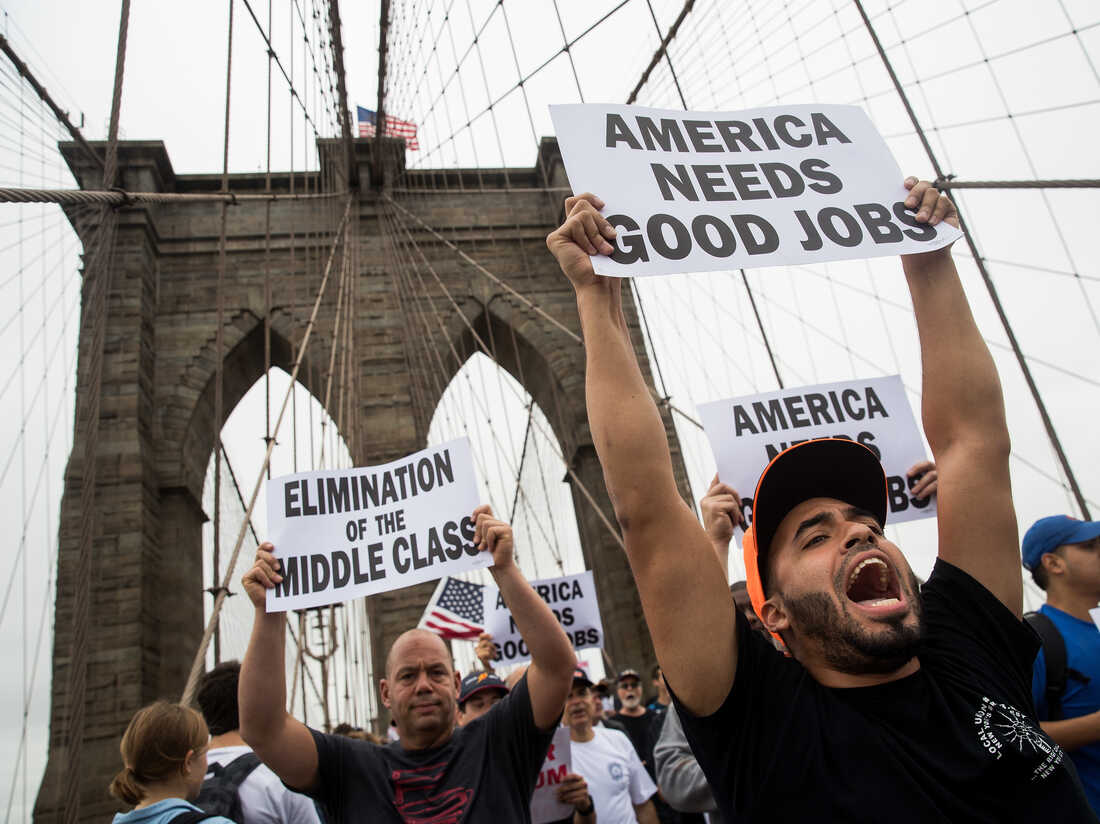
[NJFAC] unionization rate down, though members numbers up [note image slogans]

....
Headline writers began declaring things like, "Employees everywhere are organizing" and that the United States was seeing a "union boom." In September, the White House asserted "Organized labor appears to be having a moment."

However, the Bureau of Labor Statistics recently released its union data for 2022. And their data shows that — far from a resurgence — the share of American workers in a union has continued to decline. Last year, the union membership rate fell by 0.2 percentage points to 10.1% — the lowest on record. This was the second year in a row that the union rate fell. Only one in ten American workers is now in a union, down from nearly one in three workers during the heyday of unions back in the 1950s.
To be sure, various data makes clear that the hubbub over a union resurgence last year wasn't all hype. For one, the absolute number of American workers in unions did, in fact, grow in 2022 — by approximately 200,000. It's just that the number of non-union jobs grew faster. The National Labor Relations Board saw 2,510 union representation petitions filed in fiscal year 2022 — a 53% increase over the previous year. That's hardly a game-changer, but it's something.....

Following a rally in Brooklyn's Cadman Plaza Park, hundreds of union members march across the Brooklyn Bridge in support of IBEW Local 3 (International Brotherhood of Electrical Workers), September 18, 2017, in New York City.


--
June Zaccone
National Jobs for All Network
http://www.njfac.org

--
This list is only for announcements, so you may not post. To contact the list manager, write to junez [at] njfac.org
---
You received this message because you are subscribed to the Google Groups "goodjobs" group.
To unsubscribe from this group and stop receiving emails from it, send an email to goodjobsforall+unsubscribe@googlegroups.com.
To view this discussion on the web visit https://groups.google.com/d/msgid/goodjobsforall/CAPV%3DhmDpoik%2B5TRX_YFtEbgw34C1a2OqARastxkO8R91-2HFmw%40mail.gmail.com.