Wednesday, August 14, 2024

[NJFAC] Manufacturing Jobs: Unions Made Them Good, Not the Factories--Dean Baker

Manufacturing Jobs: Unions Made Them Good, Not the Factories--Dean Baker

The effort to bring back manufacturing jobs has been a major theme in the 2024 election. Both parties say they consider this a high priority for the next administration. However, there is a notable difference in that the Biden-Harris administration has actively supported an increase in unionization, while the Republicans have indicated, at best, neutrality if not outright hostility towards unions.

This distinction is important in the context of manufacturing jobs. Many people seem to assume that manufacturing jobs are automatically good jobs, paying more than non manufacturing jobs.

While that was true four decades ago, before the massive job loss of manufacturing jobs due to trade, it is not clear this is still the case. The figure below shows the average hourly pay, in 2024 dollars, for production and non supervisory workers in manufacturing and elsewhere in the private sector.[1]
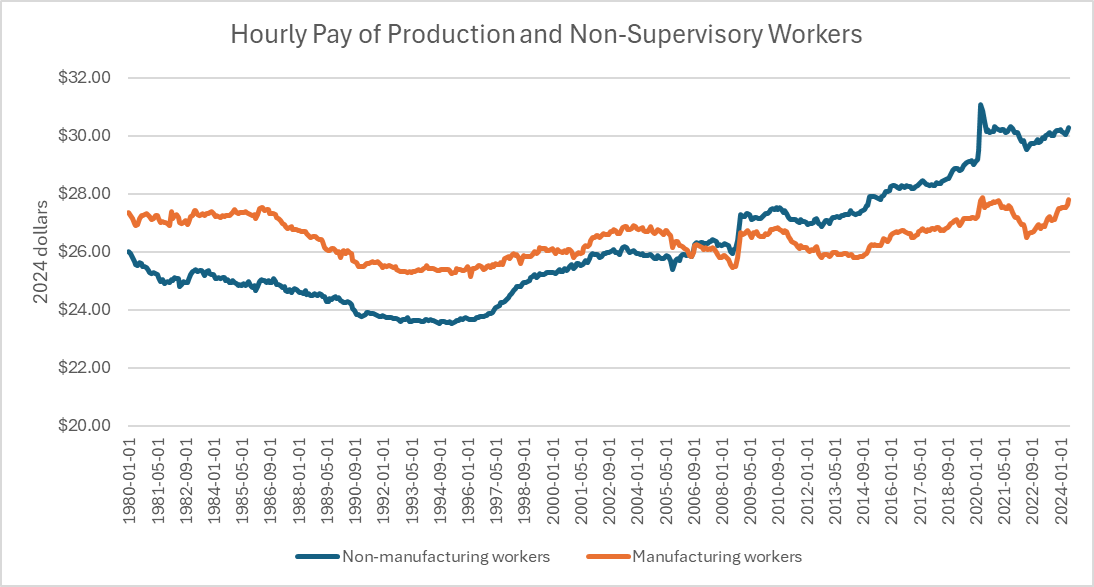
Source: Bureau of Labor Statistics and author's calculations.

As can be seen, workers in manufacturing had a substantial edge in pay at the start of this period, earning a premium of more than 5.0 percent over their counterparts in other industries. However, this flipped in 2006, and since then pay for non manufacturing workers has outpaced pay for workers in manufacturing. In the most recent data, non manufacturing workers get almost 9.0 percent more in hourly pay than workers in manufacturing.

To be clear, this is not a comprehensive comparison of relative pay. A full comparison would have to incorporate benefits and also adjust for differences in the workforce, such as education and location. An analysis done by Larry Mishel at the Economic Policy Institute in 2018 found that there was still a substantial premium for manufacturing workers over the years 2010-2016 when controlling for these factors. A more recent analysis from the Federal Reserve Board found that this premium had disappeared altogether, even when controlling for these factors.

While further research may produce different results, there is little doubt that the manufacturing premium has been sharply reduced, if not eliminated altogether, over the last four decades. The main reason for the decline in the premium is not a secret. There has been a huge drop in the percentage of manufacturing workers who are unionized.

In 1980, 32.3 percent of manufacturing workers were union members. This compares to a unionization rate of 15.0 percent for the rest of the private sectors. By comparison, in 2023 just 7.9 percent of manufacturing workers were union members, only slightly higher than the 5.9 percent rate for the private sector as a whole.

The implication of the loss of the wage premium coupled with the decline in unionization rates is that there is little reason to believe that an increase in the number of manufacturing jobs will mean more good jobs unless they are also unionized. It is not the factories that make these jobs good jobs, it is the unions.

[1] The category of production and non supervisory workers includes roughly 80 percent of the workforce. It excludes managers and highly paid professionals, so changes in pay at the top end will not have much impact on these data.

--
June Zaccone
National Jobs for All Network
http://www.njfac.org

--
This list is only for announcements, so you may not post. To contact the list manager, write to junez [at] njfac.org
---
You received this message because you are subscribed to the Google Groups "goodjobs" group.
To unsubscribe from this group and stop receiving emails from it, send an email to goodjobsforall+unsubscribe@googlegroups.com.
To view this discussion on the web visit https://groups.google.com/d/msgid/goodjobsforall/CAPV%3DhmD-ziZfLPeg4Nnu96t44SO8EPQv%3D1TN85Qy4AfHcx5W0A%40mail.gmail.com.

Monday, August 12, 2024

[NJFAC] Effect of AI Adoption on Jobs

The Effect of AI Adoption on Jobs: Evidence from USCommuting Zones August 12, 2024 Bonfiglioli, Crinò, Gancia, & Papadakis, Voxeu 8/24 Harnessing the potential of artificial intelligence has become one of the top priorities for policymakers around the world. Yet, doing so first requires a thorough understanding of the effects of these technologies on labour markets. Using data across US commuting zones over the period 2000-2020, this column presents evidence that AI adoption has reduced employment, except in high-paying occupations and those requiring a degree in STEM disciplines.

....

Between 2000 and 2020, the employment share of AI-related occupations has almost doubled in the US, rising from 0.14% to 0.20%. Most of this increase has taken place after 2010. There are sizable differences in the diffusion of AI technologies across industries. AI adoption is most prevalent in the service sector, especially in advanced branches such as information, professional, scientific and business services. It is also important in some utilities, such as electricity, and in some areas of the public sector, such as national security and international affairs. Conversely, AI adoption is still limited in manufacturing. This feature distinguishes AI adoption from the use of industrial robots, which is mostly concentrated in the manufacturing sector (Acemoglu and Restrepo 2020).....

Conclusions

Recent improvements in the field of AI have triggered much hype about the future of work. While nobody can predict the exact direction that new innovations and applications will take, we think that it is important to start from understanding the consequences that these technologies have already had. Our results point toward robust negative effects of AI adoption on employment for most workers and sectors. While more micro-level evidence is needed to precisely identify the mechanism through which these negative effects unfold, our evidence is nevertheless consistent with the view that AI is contributing to the automation of jobs and to widening inequality.


--
June Zaccone
National Jobs for All Network
http://www.njfac.org

--
This list is only for announcements, so you may not post. To contact the list manager, write to junez [at] njfac.org
---
You received this message because you are subscribed to the Google Groups "goodjobs" group.
To unsubscribe from this group and stop receiving emails from it, send an email to goodjobsforall+unsubscribe@googlegroups.com.
To view this discussion on the web visit https://groups.google.com/d/msgid/goodjobsforall/CAPV%3DhmB9sDB6Jfu5d8t_EPTiH1vL8uftf8_krwUG0Udt4DvGsw%40mail.gmail.com.

Sunday, August 4, 2024

[NJFAC] Eliminating non-competes improves workplace conditions

Are Non-Competes Really Ending?

The Federal Trade Commission proposed a full ban in April. What's the status of that ban? Plus, more than a dozen states have acted after the effort of journalists, lawyers, regulators, and citizens.

"My employer comes far too close to owning me than should be possible in a 'free' country." - Anonymous commenter to the FTC

Over the past year, lawyers and human resource experts are starting to recommend an unusual strategy for corporate America. Treat your employees better.

A few months ago, for instance, James Moore & Co., an accounting and services corporation, suggested to clients that they start the "enhancing workplace conditions, offering competitive compensation packages and providing opportunities for career development and advancement." In late July, Steven Clark of Wealth Management magazine wrote that "firms may need to focus more on creating a positive work environment and attractive compensation packages to retain talent."

Why? Because non-compete agreements, which are standard contractual provisions for tens of millions of employees that lock them to their current employer, are getting harder and harder to impose and enforce. Firms are removing non-competes from employment contracts, big law lawyers are launching complex sites for their clients on how to track what contracts are outlawed, corporate CEOs are starting to brag that they do not force employees to sign non-competes, and creative labor-focused lawyers like Matt Bruenig are taking on cases and voiding these provisions in front of newly sympathetic judges.....

--
June Zaccone
National Jobs for All Network
http://www.njfac.org

--
This list is only for announcements, so you may not post. To contact the list manager, write to junez [at] njfac.org
---
You received this message because you are subscribed to the Google Groups "goodjobs" group.
To unsubscribe from this group and stop receiving emails from it, send an email to goodjobsforall+unsubscribe@googlegroups.com.
To view this discussion on the web visit https://groups.google.com/d/msgid/goodjobsforall/CAPV%3DhmDCn%2BRdjbFA%2BSGn5Adie%2BJCn3vQAO4ktHn2xFj8kGik%3Dg%40mail.gmail.com.

Tuesday, July 30, 2024

[NJFAC] Inequality and its impact on climate, child poverty, democracy

The Spirit Level at 15 Income Inequality July 22, 2024

In 2009, the bestselling and award winning book, The Spirit Level, sounded the alarm on the corrosive effects of economic injustice. At a time when only a few academics were exploring this issue, the book provided a comprehensive analysis linking the negative effects of inequality to a wide range of social ills – from higher rates of imprisonment and mental health issues to eroded trust within society. It revolutionised the way we looked at, measured and understood the impacts of inequality.

Authors Professor Richard Wilkinson and Professor Kate Pickett, along with the Equality Trust, have released an update which revisits its original research with new data and analyses. It introduces two new indices, and expands on the original Spirit Level to offer updated data on a total of 27 newly analysed dimensions. It underscores how inequality harms us all and lies at the root of our escalating environmental, health and social crises. Its message is a rallying cry to reject the false narratives that have justified inaction, and to boldly confront systemic inequalities.

The Spirit Level at 15 shows for the first time how greater income inequality is particularly bad for the climate. It finds that nations with high levels of equality have the greatest focus on reducing carbon emissions, while the richest 10% of the population are responsible for more than half of all global emissions. It shows how inequality impacts every aspect of society, including our economy, highlighting that the UK's record on child poverty in recent years is not an aberration, but what is expected in a country this unequal.....

Findings on democracy and trust underline warning signs from the general election: inequality dramatically lowers trust, social cohesion, and levels of democracy. The rise of the far right and collapsing trust in democratic institutions across the world has gone hand-in-hand with exploding wealth and power for the ultra-rich. This should worry us all. ....

--
June Zaccone
National Jobs for All Network
http://www.njfac.org

--
This list is only for announcements, so you may not post. To contact the list manager, write to junez [at] njfac.org
---
You received this message because you are subscribed to the Google Groups "goodjobs" group.
To unsubscribe from this group and stop receiving emails from it, send an email to goodjobsforall+unsubscribe@googlegroups.com.
To view this discussion on the web visit https://groups.google.com/d/msgid/goodjobsforall/CAPV%3DhmBnygcZLFDsJf%2Bk%2B7C%2BA9bE9eBVncfvajk75jK8mCSxtg%40mail.gmail.com.

Tuesday, July 16, 2024

[NJFAC] A New Era of Endless Labor Shortages?


Article by Thomas Ferguson and Servaas Storm

The McKinsey report's highlighting of an extremely high job vacancy ratio in recent years does not reflect the true state of the U.S. labor market.

Excerpt:

"Every so often a publication comes along that more or less perfectly captures the Zeitgeist of world business elites. So it was on the 26th of June when the McKinsey Global Institute issued a new report: "Help Wanted: Charting the Challenge of Tight Labor Markets in Advanced Economies."

The message its few pages of charts and text deliver is dire indeed: "Labor markets in advanced economies today are among the tightest in two decades, not merely a pandemic-induced blip but rather a long-term trend that may continue as workforces age."

However, "There is no doubt that the rise in the job vacancy ratio is spurious, i.e., not related to real labor-market tightness, but instead most likely caused by a sharp increase in manipulative job postings."


--
June Zaccone
National Jobs for All Network
http://www.njfac.org

--
This list is only for announcements, so you may not post. To contact the list manager, write to junez [at] njfac.org
---
You received this message because you are subscribed to the Google Groups "goodjobs" group.
To unsubscribe from this group and stop receiving emails from it, send an email to goodjobsforall+unsubscribe@googlegroups.com.
To view this discussion on the web visit https://groups.google.com/d/msgid/goodjobsforall/CAPV%3DhmB7%2Bv9qmmoduYwwH%2B35Xrng%2BZj0paxvPHje3ihrTxW%3D3Q%40mail.gmail.com.

Wednesday, June 26, 2024

[NJFAC] Union ‘effects’ on hourly and weekly wages

Union 'effects' on hourly and weekly wages: A half-century perspective David Blanchflower Bruce V. Rauner Professor of Economics Dartmouth College; Professor of Economics University Of Glasgow Alex Bryson Professor of Quantitative Social Science, Social Research Institute University College London  25 Jun 2024

Union membership across the developed world has been falling for decades. This column uses data on wages and hours worked in the US over the last 50 years to examine whether this has led to a fall in the 'union wage premium'. The authors find that while the hourly wage premium for union members has fallen notably since the 1970s, the differential in weekly wages has remained large, driven in part by union members working longer hours. This underexplored role of unions is important for the welfare of workers whose consumption is dependent not only on a decent hourly wage, but the offer of sufficient paid hours of work.

Across the developed world the proportion of workers who are union members has been declining for decades (Garnero et al. 2017).  Today the rate of membership in the US stands at 33% in the public sector.  In the private sector it is 6%, down from 24% 50 years ago. 

This decline is perceived by some to be indicative of a shift in bargaining power between employers and workers which has resulted in a decline in labour's share of income (Summers and Stansbury 2020).  Since the root of a union's ability to bid up wages above the market rate is its ability to call on its members to support its bargaining position and, if necessary, withdraw its labour through strike action, one might expect this decline in union density to have resulted in a secular decline in the union wage premium – the mark up unions achieve over the wage similar workers would get in the absence of the union.  But has it? The short answer is no.

....

source: nakedcapitalism.com

--
June Zaccone
National Jobs for All Network
http://www.njfac.org

--
This list is only for announcements, so you may not post. To contact the list manager, write to junez [at] njfac.org
---
You received this message because you are subscribed to the Google Groups "goodjobs" group.
To unsubscribe from this group and stop receiving emails from it, send an email to goodjobsforall+unsubscribe@googlegroups.com.
To view this discussion on the web visit https://groups.google.com/d/msgid/goodjobsforall/CAPV%3DhmBBoHaRJuGpNDV%2BMj4wqZKcDoo-H-kTnpbpxH%3DfYCqGXQ%40mail.gmail.com.

Sunday, June 2, 2024

[NJFAC] expanding union movement in the South

David McCall, international president of the United Steelworkers Union (USW).

Independent Media Institute

....

Local 1025 [USW] members shared firsthand accounts of how the union boosted their wages, gave them a voice, and kept them safe on the job. And in May 2024, the workers at Tarboro filed for an election to join the USW.

They're among a growing number of workers across the South eager to leverage the power of solidarity and build brighter futures, even as CEOs and Republicans in this part of the country still conspire to hold them down.

....

About 1,400 workers at the Blue Bird electric bus factory in Fort Valley, Georgia, in 2023 voted overwhelmingly to organize through the USW.

The vote was a breakthrough for workers on the front lines of a vital, growing industry. It also sent a pointed, defiant message to a Republican governor who lies about unions and tries to prevent Georgians from joining them.

On the heels of that monumental victory, autoworkers at a Volkswagen plant in Chattanooga, Tennessee, overcame Republican opposition and voted by a huge majority to unionize.....

Unions lift up entire communities, a U.S. Treasury Department report confirmed in 2023.

They raise members' wages by as much as 15 percent, creating a competitive environment in which non-unionized employers also must increase pay to hold on to workers. Union contracts provide workers with better benefits and retirement security than they'd otherwise earn, and their focus on workplace safety "can pull up whole industries," the report concluded.

Unions fight favoritism and discrimination, creating more equitable workplaces and communities. The collective spirit forged inside the organized shop extends beyond the plant gates, with union members not only voting more often than other workers but also volunteering and donating to charity more often.....

--
June Zaccone
National Jobs for All Network
http://www.njfac.org

--
This list is only for announcements, so you may not post. To contact the list manager, write to junez [at] njfac.org
---
You received this message because you are subscribed to the Google Groups "goodjobs" group.
To unsubscribe from this group and stop receiving emails from it, send an email to goodjobsforall+unsubscribe@googlegroups.com.
To view this discussion on the web visit https://groups.google.com/d/msgid/goodjobsforall/CAPV%3DhmCo%2BgrxtK64O%2BOXP0tGRddM_o554NKyejo0%3DjFi0sKW_Q%40mail.gmail.com.