Saturday, October 7, 2023

[NJFAC] Autoworkers win significant victory

Striking Autoworkers Win Shock Victory

Time for the losers and haters to eat crow Ken Klippenstein Oct 6, 2023

On Thursday, The New York Times declared the United Auto Workers' (UAW) president Shawn Fain "a confrontational figure who vilifies the automakers while alarming Wall Street" amid the UAW's strike.

The article, a profile of the newly-elected Fain, went on to describe him as "caustic," "sharp-edged," a "rebel." You get the idea: the stuff that causes monocles to fall to the ground and shatter. (In fairness, the UAW under Fain has become more assertive, as my colleague Dan Boguslaw has amusingly reported — though I think this is just a union functioning like it's supposed to.)

"Fiery words can inspire, but they can also anger," the Times article cautioned. "Now he must prove that his hard-core tactics pay off."

It is now clear, just one day after the Times article was published, that Fain's tactics have paid off. Today, the UAW stunned onlookers with an announcement that it had won a concession so significant that the union wasn't even technically allowed to strike over it. GM has formally agreed to include battery plants in the master contract, extending the benefits of the union contract to the many non-union workers in facilities manufacturing batteries for electric vehicles.

A concession of this magnitude was almost unimaginable just weeks ago and portends well for the future of the strike.

Fiery words can inspire.

--
June Zaccone
National Jobs for All Network
http://www.njfac.org

--
This list is only for announcements, so you may not post. To contact the list manager, write to junez [at] njfac.org
---
You received this message because you are subscribed to the Google Groups "goodjobs" group.
To unsubscribe from this group and stop receiving emails from it, send an email to goodjobsforall+unsubscribe@googlegroups.com.
To view this discussion on the web visit https://groups.google.com/d/msgid/goodjobsforall/CAPV%3DhmDLOrNF%2BbcT2M3tj6qDjS668MG3RPXxROZrd0JMdA%3DvYQ%40mail.gmail.com.

Wednesday, October 4, 2023

[NJFAC] Angus Deaton [who wrote on deaths of despair] on our inequality

....Rare for an economist, Deaton offers a lucid and unsparing critique of America's political system. From healthcare to taxation to poverty to regulations, Deaton sees a system that has increasingly served monopolistic corporations and the rich over ordinary citizens, allowing "a minority to prey on the majority."
....
  • Less well-educated Americans have seen little or no improvement in their material circumstances for more than fifty years. For men without a four-year college degree, median real wages have trended downward since 1970."
  • "There are several million Americans — Black, white, and Hispanic — who live in households with per capita income of a few dollars a day and whose living standards are arguably as bad as or worse than those that the World Bank demarcates as destitute in India or Ethiopia."
  • "The top 10 percent of incomes in the United States account for nearly half of all income, compared with only 14 percent for the bottom half of incomes."
  • "Overall death rates in the United States have been rising, and, even before the pandemic, adult life expectancy has fallen for ten years for those without a four-year college degree.".....
Deaton sees economists as largely as complicit in the changes that have made life harder for millions of Americans. He argues that many (but not all) of the people in his profession have provided an intellectual legitimacy for a range of policies that have stripped away support for working-class Americans and forced them into an increasingly cutthroat labor market.

"They are apostles for the globalization and technical change that have enriched an elite and have redistributed income and wealth from labor to capital, all the while destroying millions of jobs, hollowing out communities, and worsening the lives of their occupants," Angus writes. "And when confronted with deaths of despair, they can blame the victims and those who try to help them."

Going forward, Deaton urges the economics profession to think more about "predistribution — the mechanisms that determine the distribution of income in the market itself, before taxes and transfers — and less about a redistribution that is not going to happen and is not what people want in any case." That, he stresses, will force many economists into "uncomfortable territory: promoting unions, place-based policies, immigration control, tariffs, job preservation, industrial policy, and the like. We need to promote a more realistic understanding of how governments and markets work. We need to abandon our sole fixation on money as a measure of human wellbeing."
....

This is wise policy. After income is already paid, many recipients are likely to resist relinquishing some. Predistribution avoids this. Methods include a national job guarantee at decent wages, though we should still consider a return to the higher taxes that predated Reagan.   jz


--
June Zaccone
National Jobs for All Network
http://www.njfac.org

--
This list is only for announcements, so you may not post. To contact the list manager, write to junez [at] njfac.org
---
You received this message because you are subscribed to the Google Groups "goodjobs" group.
To unsubscribe from this group and stop receiving emails from it, send an email to goodjobsforall+unsubscribe@googlegroups.com.
To view this discussion on the web visit https://groups.google.com/d/msgid/goodjobsforall/CAPV%3DhmBNUFmV_rz1iVUmfQw5gN4vRUiebTE6HtMoNongfCPPfA%40mail.gmail.com.

Sunday, October 1, 2023

[NJFAC] Widening mortality gap adults with and without a BA: note current declining LE for both;see commentary on labor power

Accounting for the widening mortality gap between American adults with and without a BA

Anne Case Professor of Economics and Public Affairs - Princeton University
Angus Deaton September 27, 2023


Inline image

"GDP may be doing great, but people are dying in increasing numbers, especially less-educated people," Anne Case, one of the authors, said in an interview with The Brookings Institution. "A lot of the increasing prosperity is going to the well-educated elites. It is not going to typical working people."

She and co-author Angus Deaton, the winner of the 2015 Nobel Prize in economics, both of Princeton University, analyzed U.S. death certificate information, including the age of death, cause of death, and educational attainment. They found that life expectancy for the college educated in 2021 was eight-and-a-half years longer than for the two-thirds of American adults without a bachelor's degree. That's more than triple the 1992 gap of about two-and-a-half years.

....

Deaths of despair were the leading driver of the widening mortality gap over the past 30 years, but the gap also widened for most other major causes of death, the paper notes. Cancer mortality, for instance, has declined overall but it has declined more for people with college degrees.

....

This is not a story about education. This is a story about inequality. .... as Case and Deaton make clear, college degrees here are a proxy for socioeconomic class, and the differing life experiences that America inflicts on different classes.

....For all of the complexity of America's socioeconomic problems, the overriding practical solution to most of them is straightforward: Labor power must increase. Union density must go up. More workers must be able to organize and collectively bargain and strike. Remember a couple months ago when the Teamsters won a healthy six-figure pay package for hundreds of thousands of UPS workers, by exerting unified labor power? Yeah. That's how it's done. Blue collar jobs held by people without college degrees do not automatically carry with them shitty pay and nonexistent benefits leading directly to poor health and despair and death, due to some sort of natural economic law.....


--
June Zaccone
National Jobs for All Network
http://www.njfac.org

--
This list is only for announcements, so you may not post. To contact the list manager, write to junez [at] njfac.org
---
You received this message because you are subscribed to the Google Groups "goodjobs" group.
To unsubscribe from this group and stop receiving emails from it, send an email to goodjobsforall+unsubscribe@googlegroups.com.
To view this discussion on the web visit https://groups.google.com/d/msgid/goodjobsforall/CAPV%3DhmDQywmusHrtFcA9mDmc4y2PianrhkaaWb%2BghPEywzgLtQ%40mail.gmail.com.

Tuesday, September 26, 2023

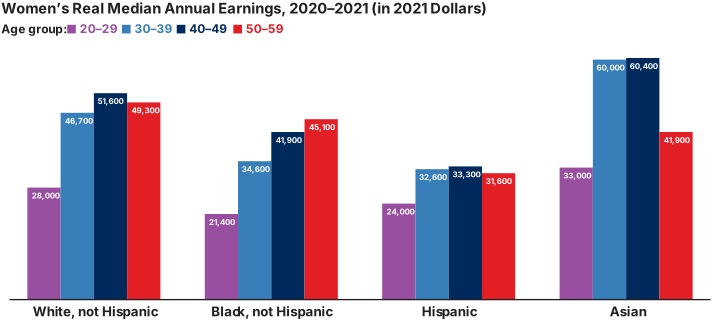
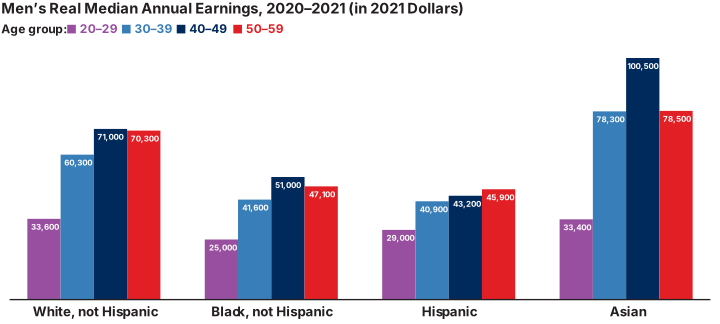
[NJFAC] Earnings of Men, Women Aged 20–59, by Age Group and Race/Ethnicity, 2020–2021

Earnings of Men, Aged 20–59, by Age Group and Race/Ethnicity, 2020–2021

Released: September 2023

DEFINITION: Earnings consist of all wages, salaries, and self-employment income in covered and noncovered employment, including earnings that exceed the annual taxable maximum.

In the 2-year period 2020–2021:

  • For the 20–29 age group, the real median annual earnings of:
    • White, non-Hispanic men were 34% higher than Black, non-Hispanic men and 16% higher than Hispanic men.
    • Asian men were 34% higher than Black, non-Hispanic men and 15% higher than Hispanic men.
  • For the 50–59 age group, the real median annual earnings of:
    • White, non-Hispanic men were 49% higher than Black, non-Hispanic men and 53% higher than Hispanic men.
    • Asian men were 67% higher than Black, non-Hispanic men 71% higher than Hispanic men.

Earnings of Women Aged 20–59, by Age Group and Race/Ethnicity, 2020–2021

Released: September 2023

DEFINITION: Earnings consist of all wages, salaries, and self-employment income in covered and noncovered employment, including earnings that exceed the annual taxable maximum.

In the 2-year period 2020–2021:

  • For the 20–29 age group, the real median annual earnings of:
    • White, non-Hispanic women were 31% higher than Black, non-Hispanic women and 17% higher than Hispanic women.
    • Asian women were 54% higher than Black, non-Hispanic women and 38% higher than Hispanic women.
  • For the 50–59 age group, the real median annual earnings of:
    • White, non-Hispanic women were 9% higher than Black, non-Hispanic women and 56% higher than Hispanic women.
    • Asian women were 7% lower than Black, non-Hispanic women and 33% higher than Hispanic women.

SOURCE: Social Security Administration (SSA) calculations using SSA earnings data linked to Current Population Survey Annual Social and Economic Supplement public-use files.

NOTES: Earnings are indexed to 2021 values based on the Consumer Price Index for All Urban Consumers.

Includes workers with annual earnings equal to or greater than one earnings credit. In current dollars, the earnings required to earn a single credit were $1,410 in 2020 and $1,470 in 2021.

Current Population Survey data were merged for the 2-year period 2020–2021 to reduce annual variability that can occur when sampling relatively small demographic groups.


--
June Zaccone
National Jobs for All Network
http://www.njfac.org

--
This list is only for announcements, so you may not post. To contact the list manager, write to junez [at] njfac.org
---
You received this message because you are subscribed to the Google Groups "goodjobs" group.
To unsubscribe from this group and stop receiving emails from it, send an email to goodjobsforall+unsubscribe@googlegroups.com.
To view this discussion on the web visit https://groups.google.com/d/msgid/goodjobsforall/CAPV%3DhmCKVC3Zsy%3DSNbRQWybTCgOc_oPG%2Bkgag-DBjbBXa%3Dq1yw%40mail.gmail.com.

Saturday, September 16, 2023

[NJFAC] Former Prisoners as employees

Why Criminal Justice Reform Is Becoming a Corporate Priority

Business opportunity and ethical concerns are lining up to change hiring practices and policies to give those with criminal records a second chance. By Will Maddox | September 11, 2023

....
Research shows that 70 to 100 million Americans have a criminal record, around one in three working-age adults. Sixty percent of them are unemployed a year after leaving prison. This group is underutilized and bypassed for the millions of jobs that remain open across all industries, but the winds are shifting.
Justice-impacted individuals face several challenges to reentering the workforce and staying out of trouble. These barriers, imposed by legislation, law enforcement, employers, and society, make it more likely that they'll run afoul of the law again. But several businesses are taking the bold step to be the leading edge of the movement to put this group of people to work.

The Responsible Business Initiative for Justice compiled data to show that justice-impacted individuals compare well to the average employee. A survey of human resource professionals and managers found that 83 percent rated the job performance of justice-impacted individuals to be as good or better than the average worker, and about three-fourths found that justice-impacted workers are as or more dependable than the average employee. Seventy percent said job retention was also better for justice-impacted individuals.....

This potential labor force faces many barriers, experts say. First, employers must be willing to take a chance on justice-impacted applicants. Second, those individuals need access to various services to help them get up to speed and become stable and ready to enter the workforce. And lastly, policies need to be updated to help people transition. Success will require progress in all three areas....


--
June Zaccone
National Jobs for All Network
http://www.njfac.org

--
This list is only for announcements, so you may not post. To contact the list manager, write to junez [at] njfac.org
---
You received this message because you are subscribed to the Google Groups "goodjobs" group.
To unsubscribe from this group and stop receiving emails from it, send an email to goodjobsforall+unsubscribe@googlegroups.com.
To view this discussion on the web visit https://groups.google.com/d/msgid/goodjobsforall/CAPV%3DhmCDN4PBgY-e_vtyhrsF%3DA4BTvuj54UiPAyJxi80S1_nsg%40mail.gmail.com.

Tuesday, September 5, 2023

[NJFAC] AI threats to workers

MIT Economist Daron Acemoğlu Takes on Big Tech: "Our Future Will Be Very Dystopian" The rich and powerful have hijacked progress throughout history, says Daron Acemoğlu. They did so back in the Middle Ages and also now in the age of artificial intelligence. In an interview, the MIT economist dives into the question of whether Silicon Valley is plunging humanity into destitution. https://www.spiegel.de/international/business/mit-economist-daron-acemoglu-takes-on-big-tech-our-future-will-be-very-dystopian-a-6b9feec3-2d8a-4916-8f3f-dd4401bff083?s Interview By Benjamin Bidder 28.08.2023

....

Acemoğlu: In the United States, for 40 years, we have had declines in the real earnings of workers without a college degree. The decline amounts to around a half a percentage point per year. This is an enormous amount. If nothing changes, AI is going to double down on that. AI might still become very useful for well-off citizens, knowledge workers and highly skilled employees. But it is not going to be good for most people on its current path.

....
Labor Economist: AI May Bring a Boom in Horrible Jobs Interview by Lynn Parramore, featuring Nadia Garbellini
Losing jobs isn't the only thing workers have to worry about. AI may make many jobs worse.

"What concerns me, more than the disappearance of jobs, is the quality of the new ones in terms of working conditions, wages, autonomy, alienation, etc. What I fear is a world with millions of underpaid, ignorant, politically naive, isolated workers, stuck at home in front of their computers in both work and leisure time, producing goods and services they cannot afford to buy."
....

--
June Zaccone
National Jobs for All Network
http://www.njfac.org

--
This list is only for announcements, so you may not post. To contact the list manager, write to junez [at] njfac.org
---
You received this message because you are subscribed to the Google Groups "goodjobs" group.
To unsubscribe from this group and stop receiving emails from it, send an email to goodjobsforall+unsubscribe@googlegroups.com.
To view this discussion on the web visit https://groups.google.com/d/msgid/goodjobsforall/CAPV%3DhmA2kqFb1ZyL-7ufqiAJsj3HrFOLDoa5_MEJoX-5AFQoEg%40mail.gmail.com.

Saturday, September 2, 2023

[NJFAC] Executive Excess 2023: IPS on 100 corporations with lowest median worker pay

Executive Excess 2023 Sarah Anderson

Introduction:

In response to strikes and union organizing drives, corporate leaders routinely insist they simply lack the resources to raise employee pay.

And yet top executives seem to have little trouble finding enough to enrich themselves and wealthy shareholders. In 2021 and 2022, S&P 500 corporations spent record sums on stock buybacks, a maneuver that artificially inflates the value of a company's stock — and CEOs' stock-based pay.

All employees contribute to company profits. But instead of broadly sharing the wealth, companies are using a once-illegal form of market manipulation to make those at the top of the corporate ladder even richer.

This 29th annual Executive Excess report takes an in-depth look at the 100 S&P 500 corporations that had the lowest median worker pay levels in 2022, a group we've dubbed the "Low-Wage 100." For each of these firms, we report the total compensation and personal stock holdings of CEOs, the CEO-worker pay gap, and the overall outlays for stock buybacks.

We also reveal how taxpayers are enriching ― through federal contracts ― the majority of the Low-Wage 100. And we conclude with the most comprehensive available policy menu for achieving a fair corporate compensation system.

The full report — complete with comprehensive findings, recommendations, and methodology, along with data for each of the 100 companies we studied — is available here. A summary follows.

Key Findings

1. The CEO-worker pay gap at the Low-Wage 100 averaged 603 to 1 in 2022.

  • Chief executives in this group raked in $15.3 million on average in 2022, while median worker pay averaged just $31,672.
  • Live Nation Entertainment had the fattest CEO paycheck and the widest pay gap. Michael Rapino hauled in $139 million, 5,414 times as much as his firm's median of $25,673.

2. The Low-Wage 100 have spent more than $340 billion on stock buybacks since 2020.

  • Between January 1, 2020 and May 31, 2023, 90 of the Low-Wage 100 reported combined stock buyback expenditures of $341.2 billion. This maneuver artificially inflates executive stock-based pay and siphons funds from worker wages and other productive investments.
  • Lowe's led the buybacks list, spending $34.9 billion on share repurchases over the past three and a half years. In 2022 alone, Lowe's spent more than $14.1 billion on buybacks — enough to give every one of its 301,000 U.S. employees a $46,923 bonus.
  • Home Depot came in second, with $28.9 billion in stock buybacks since January 2020, and Walmart ranks third, with $23.9 billion.

3. During their stock buyback spree, Low-Wage 100 CEOs' personal stock holdings increased more than three times as fast as their firms' median worker pay.

  • The CEOs of the 90 low-wage S&P 500 companies that have spent funds on buybacks since 2020 have amassed approximately $14.9 billion worth of their company stock.
  • At the 65 buyback companies where the same person held the top job between 2019 and 2022, the CEOs' personal stock holdings soared 33 percent to an average of $184.7 million. Median pay at these firms rose only 10 percent to an average of $31,972 (not adjusted for inflation).
  • FedEx CEO Frederick Smith has the largest stockpile in the Low-Wage 100. His personal holdings have grown 65 percent to more than $5 billion since January 2000. By contrast, FedEx median worker pay fell by 20 percent to $39,177 (including $9,267 in health benefits) between 2019 and 2022.

4. Over half of the Low-Wage 100 receive taxpayer-funded federal contracts.

  • Of the 100 companies in our sample, 51 received federal contracts worth a combined $24.1 billion during fiscal years 2020-2023. These low-wage federal contractors spent nearly $160 billion on stock buybacks over the course of these years.
  • In 2022, the average CEO pay in this low-wage contractor group stood at $12.7 million, 56 times as much as the salary of a Biden administration cabinet secretary. This group's CEOs averaged 438 times their $34,550 median worker pay.

Recommendations

Policy solutions for runaway CEO pay are gaining support.

Public outrage over executive excess is growing across the political spectrum. Policymakers have begun taking serious steps to respond. They include…

  • Stock buybacks taxes and restrictions: In the 2022 Inflation Reduction Act, Congress passed a 1 percent excise tax on CEO pay-inflating stock buybacks. President Biden proposed quadrupling this tax in his 2023 State of the Union address. Biden has also included a proposal in his federal budget plan that would ban top executives from selling their personal stock for a multi-year period after a buyback, preventing CEOs from timing share repurchases to cash in personally on a short-term price pop they themselves artificially created. A Senate bill, the ALIGN Act, would do just that.
  • Federal contractor incentives: In 2022, the Department of Commerce announced plans to give priority in the awarding of new CHIPS subsidies for domestic semiconductor manufacturing to firms that do not engage in any stock buybacks. The administration has applied a number of other pro-worker conditions on federal contracts, but federal agencies could go much further to wield the power of the public purse against inequality. The Patriotic Corporations Act could serve as a model. This bill would grant preferential treatment in contracting to firms with pay ratios of 100 to 1 or less, among other benchmarks, including neutrality in union organizing campaigns.
  • Excessive CEO pay taxes: Laws to hike corporate taxes on companies with wide CEO-worker pay gap are now raising revenue in two major cities, San Francisco and Portland, Oregon. The more recent of the two taxes, San Francisco's "Overpaid Executive Tax," became effective on January 1, 2022. In May 2023, city officials announced that they now expect the tax to bring in about $125 million per year, a higher return than originally expected. San Francisco's executive tax has also proved more resilient than other local revenue sources. Legislation similar to San Francisco's has been introduced in the U.S. House and Senate and came into play during the Build Back Better negotiations. Higher tax rates on companies with wide CEO-worker pay gaps create an incentive to both rein in executive pay and lift up worker wages, all while generating significant new capital for vital public investments.

--
June Zaccone
National Jobs for All Network
http://www.njfac.org

--
This list is only for announcements, so you may not post. To contact the list manager, write to junez [at] njfac.org
---
You received this message because you are subscribed to the Google Groups "goodjobs" group.
To unsubscribe from this group and stop receiving emails from it, send an email to goodjobsforall+unsubscribe@googlegroups.com.
To view this discussion on the web visit https://groups.google.com/d/msgid/goodjobsforall/CAPV%3DhmA49tdn4rQ8tzN0oNsn0deRNy3ieqbK4r6E4ADVdrjUPA%40mail.gmail.com.