Saturday, May 16, 2015

[NJFAC] The Deadliest Jobs in America


The Deadliest Jobs in America May 13, 2015 http://www.bloomberg.com/graphics/2015-dangerous-jobs/

The U.S. Department of Labor tracks how many people die at work, and why. The latest numbers were released in April and cover the last seven years through 2013. Some of the results may surprise you.


--
National Jobs for All Coalition
http://www.njfac.org/

--
This list is only for announcements, so you may not post. To contact the list manager, write to njfac [at] njfac.org
---
You received this message because you are subscribed to the Google Groups "goodjobs" group.
To unsubscribe from this group and stop receiving emails from it, send an email to goodjobsforall+unsubscribe@googlegroups.com.
For more options, visit https://groups.google.com/d/optout.

Thursday, May 14, 2015

[NJFAC] TPP: the Trans-Pacific Partnership

Two members of the Executive Committee of the NJFAC have written about this agreement, currently under negotiation:

Sheila Collins-- Trans-Pacific Partnership (TPP): The trade deal you aren't allowed to know about until it hits you!
                                                           http://www.njfac.org/TPP/TPP-secret.pdf  

June Zaccone--
The Trans-Pacific Partnership (TPP): A Corporate Agenda: http://www.njfac.org/TPP/TPP.pdf 
      [Done in 12/14. I am updating this a bit within the next week.j]

--
National Jobs for All Coalition
http://www.njfac.org/

--
This list is only for announcements, so you may not post. To contact the list manager, write to njfac [at] njfac.org
---
You received this message because you are subscribed to the Google Groups "goodjobs" group.
To unsubscribe from this group and stop receiving emails from it, send an email to goodjobsforall+unsubscribe@googlegroups.com.
For more options, visit https://groups.google.com/d/optout.
Saturday, May 9, 2015

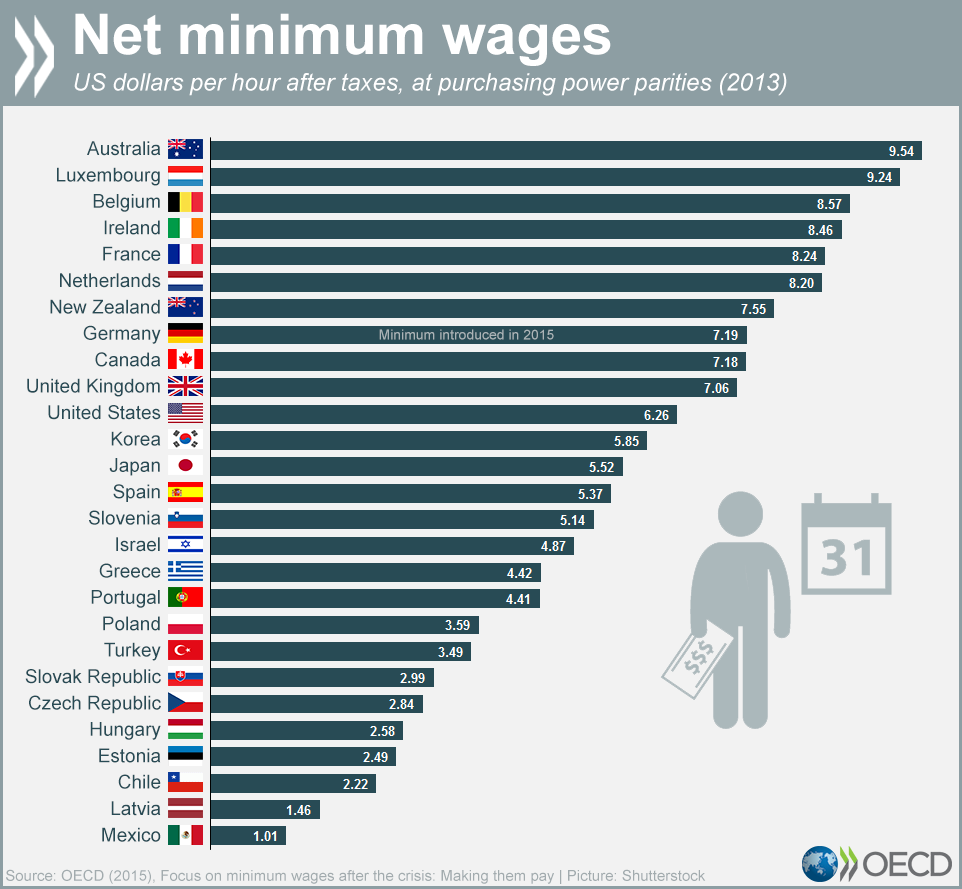
[NJFAC] US minimum wage: slightly more than SK and Japan, less than UK, Can, Ger

"Adjusted for purchasing power and including taxes, the U.S. federal minimum wage is $6.26 an hour, slightly more than in South Korea and Japan but slightly less than in the United Kingdom, Canada and Germany. Organization for Economic Cooperation and Development" Washington Post, Wonkbook 5/7/15

Embedded image permalink

Read the OECD's FOCUS on Minimum wages after the crisis: Making them pay
--
National Jobs for All Coalition
http://www.njfac.org/

--
This list is only for announcements, so you may not post. To contact the list manager, write to njfac [at] njfac.org
---
You received this message because you are subscribed to the Google Groups "goodjobs" group.
To unsubscribe from this group and stop receiving emails from it, send an email to goodjobsforall+unsubscribe@googlegroups.com.
For more options, visit https://groups.google.com/d/optout.

Wednesday, May 6, 2015

[NJFAC] Summers: jobs, not education, is the answer to inequality. "Evidence of Intelligent Life in the Economics Profession"

Evidence of Intelligent Life in the Economics Profession

By Dean Baker, published by Al Jazeera America

Last month, former Clinton Treasury Secretary and top Obama adviser Larry Summers ripped into those arguing that more education is the answer to the country's inequality problems:

"The core problem is that there aren't enough jobs. If you help some people, you could help them get the jobs, but then someone else won't get the jobs. Unless you're doing things that have things that are affecting the demand for jobs, you're helping people win a race to get a finite number of jobs."

He made these comments at a conference put on by the Robert Rubin funded Hamilton Project held at the Brookings Institution.

If the significance of these comments is not clear, the most important economic figure of the mainstream of the Democratic Party was demolishing one of the party's central themes over the last two decades. He was arguing that the problems of the labor force -- weak employment opportunities, stagnant wages, and rising inequality -- were not going to be addressed by increasing the education and skills of the workforce. Rather, the problem was the overall state of the economy.

The standard education story puts the blame for stagnant wages on workers. The key to getting ahead is getting a good education. The story Summers was telling at Brookings is that the blame is on the people who design economic policy. It is their fault that workers aren't able to secure decent paying jobs.


Read the rest of the article here.

If additional evidence were needed, California's low-wage workers earn less than in 1979, study shows

--
National Jobs for All Coalition
http://www.njfac.org/

--
This list is only for announcements, so you may not post. To contact the list manager, write to njfac [at] njfac.org
---
You received this message because you are subscribed to the Google Groups "goodjobs" group.
To unsubscribe from this group and stop receiving emails from it, send an email to goodjobsforall+unsubscribe@googlegroups.com.
For more options, visit https://groups.google.com/d/optout.

Wednesday, April 22, 2015

[NJFAC] Economy is worse off than it looks

Economists have discovered how bad the economy really is Washington Post, Wonkblog 4/21/15

Unemployment is almost back to normal, but the economy isn't. That isn't because the unemployment rate is a conspiracy to make things look better than they really are. It's because even though the unemployment rate tells us the most about the labor market, it doesn't tell us the full story.....this shadow unemployment means our jobs hole is more than three times as big as it looks. That, at least, is what economists Danny Blanchflower and Andrew Levin found when they looked at how low the unemployment rate is versus how low we think it could go, how high the participation rate is versus how high we think it could go, and how many people can only find part-time jobs.....

instead of being a million full-time jobs short, like the unemployment rate says we are, we're about 3.5 million short.


... it's not often that shadow unemployment is a bigger problem than regular unemployment, but this is one of those times.

For full paper, Labor Market Slack and Monetary Policy, Blanchflower and Levin,  see http://www.dartmouth.edu/~blnchflr/papers/Blanchflower-Levin%20labor%20slack%2024mar2015.pdf


--
National Jobs for All Coalition
http://www.njfac.org/

--
This list is only for announcements, so you may not post. To contact the list manager, write to njfac [at] njfac.org
---
You received this message because you are subscribed to the Google Groups "goodjobs" group.
To unsubscribe from this group and stop receiving emails from it, send an email to goodjobsforall+unsubscribe@googlegroups.com.
For more options, visit https://groups.google.com/d/optout.

Sunday, April 19, 2015

[NJFAC] Helping the middle class

Raising the median wage: Policies that target the middle class

Jared Bernstein April 17th, 2015

...here are some ideas designed to meet that goal [boosting the median]:

* Full employment: Tight labor markets provide middle-wage workers with the bargaining power they lack when job markets are slack, as they have been, remarkably, 70 percent of the time since 1980. Employment is growing at a decent clip and we're headed in the right direction, but we're not there yet. That means there's still a role for accommodative monetary policy (keeping interest rates low at the Federal Reserve) and growth-oriented fiscal policy (e.g., an infrastructure investment program).

 * Trade deficits/manufacturing jobs: We've run large trade deficits for decades in this country and that's cost us millions of better-than-average factory jobs and made it harder to get to full employment (without offsetting bubbles in other sectors). Achieving a better balance between our exports and imports would thus help middle-class workers through both of those channels (more jobs in the tradable-goods sector and tighter job markets). That means taking actions against competitors who manage their currencies to subsidize their exports to us and tax our exports to them.

* Strengthen collective bargaining: While traditional unions in the private sector are down to only about 7 percent of the workforce, the power of collective action was most recently demonstrated by the low-wage workers and their advocates noted above. Moreover, there's a strikingly negative correlation over time between the decline in union density and the share of income going to the top 10 percent (see Figure 32 here). The decline of unions and the ensuing loss of bargaining power is thus a clear factor in middle-class economic insecurity. That means going after state "right-to-work" laws (which undermine bargaining units by allowing for free-riders) and the sharply uneven playing field for those who want to form a union.

* Mid-market employment: There's an incorrect notion that all the middle-class jobs have dried up — we're now a nation of derivative traders and low-end service workers who serve them their food and dry-clean their suits. Wrong, says economist Harry Holzer, who has dived deeply into these waters and found growing demand for mid-level jobs in certain occupations. What's missing is a) enough labor demand to boost the wage offers in these jobs (see "full employment" above) and b) the necessary skill sets. That means developing "a new set of education and training policies and practices" that specifically targets mid-level growth occupations.

* Work/family balance: In our workforce, those who most need flexibility at work are often the least likely to get it. A single-parent in a low-paying, hourly job with shaky child care has the least ability to deal with a scheduling hiccup, while a denizen of the top 1 percent with Cadillac child care can typically take off whenever he or she needs to. I'd also put gender pay equity under this rubric (note median wage gender gap of 17 percent in the figure above). That means paid sick leave, robust maternal and paternal leave policies, worker-centered scheduling, rid the tax code of any discrimination against caregivers, and equal-pay-for-equal-work legislation.

....

--
National Jobs for All Coalition
http://www.njfac.org/

--
This list is only for announcements, so you may not post. To contact the list manager, write to njfac [at] njfac.org
---
You received this message because you are subscribed to the Google Groups "goodjobs" group.
To unsubscribe from this group and stop receiving emails from it, send an email to goodjobsforall+unsubscribe@googlegroups.com.
For more options, visit https://groups.google.com/d/optout.

Tuesday, April 14, 2015

[NJFAC] Living Wage Calculator; Low Wages Cost U.S. Taxpayers $152.8 Billion/Year in Public Support for Working Families

Introduction to the Living Wage Calculator   look up by state

The High Public Cost of Low Wages Ken Jacobs, Ian Perry and Jenifer MacGillvary, UC Berkeley Labor Ctr April 13, 2015

Low Wages Cost U.S. Taxpayers $152.8 Billion Each Year in Public Support for Working Families

Even as the economy has at last begun to expand at a more rapid pace, growth in wages and benefits for most American workers has continued its decades-long stagnation. Real hourly wages of the median American worker were just 5 percent higher in 2013 than they were in 1979, while the wages of the bottom decile of earners were 5 percent lower in 2013 than in 1979.